
The old supplier’s lorry turns up on Friday and takes its containers away.
The new containers arrive on Tuesday. In between, the yard fills with sacks, the kitchen caddy overflows and somebody stacks boxes by the fire exit.
That gap is the whole risk in a switch. You agreed the price weeks ago, and nobody planned the four days in the middle.
Start with the contract you already have
Most businesses decide to switch waste supplier before they read the current contract. Do it the other way round.
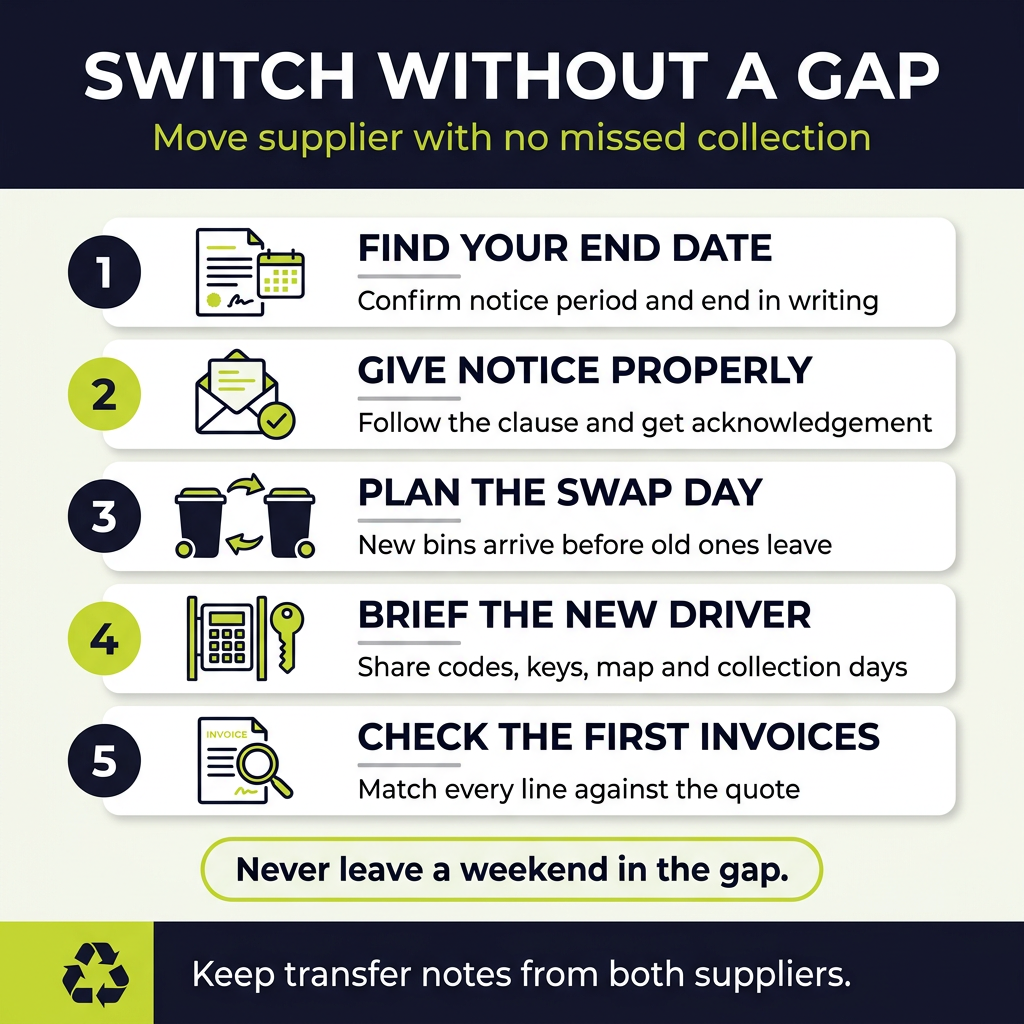
Find the signed agreement, not the sales quote. Look for three things: the end date, the notice period and the method the contract requires for notice.
Many commercial waste contracts renew on their own if you miss the notice window. Our guide to the invoice nobody reads covers auto renewal in more detail.
Get the end date in writing. Email the current supplier and ask them to confirm it, along with the notice period they hold on file. Their records and your copy do not always match.
Terms vary between contracts, so if anything is unclear, take proper advice before you act on it.
Give notice the way the contract asks
A phone call to the driver is not notice. Neither is a quick word with the account manager at a trade show.
Read the notice clause and follow it to the letter. Some contracts ask for a letter, some for an email to a set address, and some for a form.
Ask for an acknowledgement. You want a reply that confirms they received your notice and states the final collection date.
Keep that reply with the contract, because it becomes your evidence if a renewal invoice appears later.
Do not cancel the direct debit until the final invoice has cleared completely. Stopping it early can turn a clean exit into a dispute.
Work out who owns the bins
This question causes most missed collections.
If the old supplier owns the containers, they will collect them. That can happen on the last service day, or a few days after, and often with little warning.
If you own the containers, they stay. Check the new supplier can empty them. Then check the lids, wheels and labels are fit to use.
Plan the swap day. Agree with both suppliers which day the old containers leave and the new containers arrive. Ideally, it is the same day.
Ask the new supplier to deliver first, then let the old supplier remove theirs. For a short period you may have double the equipment in the yard, and that beats having none.
Compactors and balers need extra preparation. They may need a power connection, a level base or an engineer to install them, so book those well ahead.
Overlap the last collection and the first
The aim is simple: the final collection under the old contract, then the first under the new one.
Ask the old supplier for the exact date of the final collection. Give that date to the new supplier. Book their first collection for the next working day, or as near as their rounds allow.
Next day collections depend on location, so ask the new supplier what is realistic for your postcode.
Never leave a weekend in the gap. Food waste and general waste do not wait, and a hot Monday with a full caddy is a bad start.
If an overlap is impossible, book a one off collection to bridge it. It costs less than a pest problem or a blocked exit.
Site access, keys and collection days
Your previous driver knew the site, but the new driver has never visited.
Write down every access detail: gate codes, barrier fobs, key safes, height restrictions and loading bay availability.
Note where every container lives, and draw a simple map for larger yards. A driver who cannot find the bin store will mark the job as no access.
Check the collection day against your week. A Monday collection suits a restaurant after the weekend. A Friday collection suits an office that clears out before the weekend.
Tell the new supplier about anything unusual. That might mean a shared yard, a blocked gate or a bin store locked out of hours.
Keep your duty of care paperwork in line
Switching supplier does not pause your legal responsibilities. Your waste stays your responsibility from the moment you produce it.
Before the first collection, check the new supplier holds a registration to carry or broker waste. Our guide to brokers and contractors explains the difference.
Ask for the new waste transfer note before the first collection. It should describe your waste, its code, the containers and the collection pattern.
Keep the old supplier’s transfer notes as well. You still need records from before the switch for the legal retention period.
Our duty of care guide sets out the basics. Rules can differ across England, Scotland, Wales and Northern Ireland, so check with the relevant authority for your site.
In England, the switch is a good moment to confirm your streams meet Simpler Recycling for workplaces.
Hazardous or electrical waste needs a specialist route. Make sure the new contract covers it, or that it sits elsewhere on purpose.
Tell the people who use the bins
The supplier changes, but the people who fill the containers stay the same, so brief them properly.
Tell staff what the new containers look like, where they sit and which stream goes in each one. Colours, lid types and container sizes may all change.
Brief the cleaners separately. They move most of the waste, often at night, and they may work for a separate firm. Give them the new bin layout and the collection days.
Tell the person on reception or in the goods yard too. They are the ones who will see a lorry that does not turn up.
Put a short note on each bin store for the first month. A picture of the new bin with its stream beats a long email.
Check the first invoices line by line
The first two or three invoices tell you whether the switch went as agreed.
Compare them against the quote. Check the container sizes, the number of collections, the collection frequency and any delivery or set up charges.
Look for charges from the old supplier too. A late collection fee, a container removal charge or a renewal invoice can still arrive after you leave.
Query anything odd straight away. A mistake on the first invoice tends to repeat on every invoice after it.
Our guide on choosing a waste supplier covers the questions to ask before you sign.
Switching several sites at once
A single shop is one swap day. Twenty sites is a project.
Contracts often end on different dates across a group. Map every site with its current supplier, end date and notice period before you give notice anywhere.
Move in stages. Start with one or two sites, fix what goes wrong, then roll out the rest in batches.
Name one contact at each site who knows the swap day and has the new supplier’s number. Head office cannot see a full bin store from a desk.
A multi site waste service can run on one contract and one invoice. Behind it sit our own transport and a managed contractor network.
Frequently asked questions
How much notice do I need to switch waste supplier?
It depends on your contract. Check the notice clause, and ask the current supplier to confirm the end date in writing.
Will my old supplier take the containers away?
If they own the containers, yes. Agree the removal date, and have the new containers delivered on or before that day.
Can I avoid a missed collection during the switch?
Yes, if you plan it. Book the new supplier’s first collection for the next working day after the old supplier’s last one.
Do I need a new waste transfer note?
Yes. The new supplier should issue one before the first collection, and you should keep the old notes as well.
What if my contract has already renewed?
Read the renewal terms and ask the supplier what your options are. Diary the next notice window so it does not happen again.
Should a group switch all its sites at once?
Rarely. Start with a small batch, learn from it, then move the rest in stages.
The bottom line
The price is the easy part of a switch. The gap between two lorries is where it goes wrong.
Read the contract, give notice in writing and get a reply. Find out who owns the containers, then overlap the last collection and the first.
Hand the new driver the codes and a map. Brief the staff and the cleaners, and check the first invoices against the quote.
Priority Waste runs commercial waste collections across the UK from our base in Bedford. We plan the swap day with you so nothing sits in the yard. Book a free waste review, and bring your current contract.

