
Search “waste brokers“, and you will find dozens of companies who will happily quote for your bins tomorrow morning. Some of them own lorries. Some of them own nothing at all except a phone system and a spreadsheet of subcontractors.
Both models are perfectly legal. Both can serve you well. But they behave very differently when something goes wrong, and most business owners sign a contract without ever knowing which one they have hired.
Here is how to tell the difference, and what it means for your service, your price and your compliance paperwork.
Carrier, broker, dealer: three words that mean three different things
The Environment Agency splits the industry into three registered roles, and a single company can hold more than one.
A carrier physically transports controlled waste in the course of a business. If a lorry with a company name on the side empties your bin, that company is acting as a carrier.
A broker arranges for waste to be recovered or disposed of on someone else’s behalf. Crucially, a broker does not need to touch the waste at all. They take your call, price the job, and place it with a carrier who does the work.
A dealer buys and sells waste, taking legal control of it without necessarily moving it.
Every one of these roles requires registration with the Environment Agency in England. That registration is the single most useful thing you can check before you sign anything.
Upper tier and lower tier, and why the difference matters
There are two tiers of registration, and they are not interchangeable.
Lower tier registration covers businesses that only ever move their own waste. A landscaper taking their own green waste to a transfer station sits here. It is free in England, and it does not expire.
Upper tier registration is required by anyone who carries other people’s waste, carries construction or demolition waste, or acts as a broker or dealer. It costs money, it has to be renewed every three years, and the Environment Agency runs a background check before granting it.
If a company is quoting to collect your commercial waste, they must hold upper tier registration. There is no version of that job that a lower tier registration covers.
You can check any registration free of charge on the Environment Agency’s public register. You only need the company name or the CBD number. It takes about ninety seconds, and it is the closest thing to a fraud check the industry offers.
For reference, Priority Waste holds upper tier carrier and broker registration under CBDU292438.
The honest case for using a broker
Brokers get an unfairly bad name, usually from people who have used a poor one. A good broker earns their margin in three specific situations.
You have unusual or one-off waste. Nobody keeps a specialist tanker on standby for the one time a year you need a bunded tank emptied. A broker with a real supplier network will find the right operator faster than you will.
You operate across a wide geography. No single waste company owns depots everywhere in the UK. Every national service involves subcontracting somewhere. The question is whether that is disclosed to you or hidden from you.
You want one invoice instead of fifteen. Consolidating multi-site billing is genuinely valuable administrative work, and it is work somebody has to do.
Where the broker model goes wrong
The problems are consistent, and they all trace back to the same root cause: the company you pay is not the company doing the work.
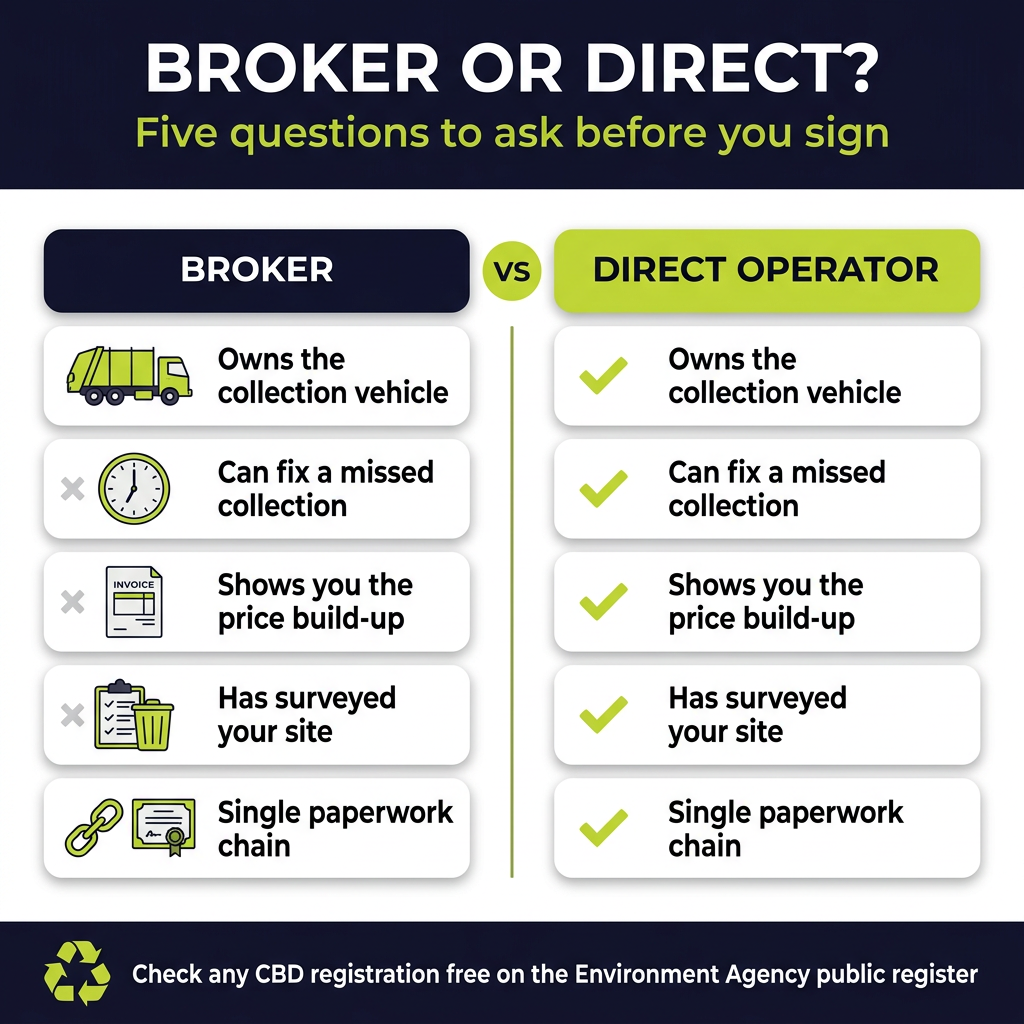
Service escalation stalls. When a collection is missed, a broker cannot send a lorry. They can only ring the operator who missed it and ask nicely. You are one customer removed from anyone who can actually fix your problem.
Price rises arrive without explanation. A broker’s margin sits between the gate fee and your invoice. When the gate fee moves, your price moves, and the reason is rarely shown on the invoice. Our guide to reading a waste invoice properly covers the specific line items to watch.
Duty of care paperwork gets messy. Your legal duty of care does not transfer to the broker. It stays with you, as the producer of the waste. Say the chain of custody has three companies in it. If one of them cannot produce a consignment note eighteen months later, that is your problem, not theirs.
Nobody has seen your site. Bin sizes, access constraints, lorry turning circles and collection windows are all decided from a desk. This is why so many businesses end up paying for a service that does not physically fit their yard.
Six questions that reveal which model you are buying
Ask these before you sign. The answers take five minutes, and they tell you almost everything.
- Do you own the vehicle that will collect from us? Not “do you have a fleet”. Ask about this collection at this site.
- What is your CBD registration number, and which tier? Then check it on the public register yourself.
- Who do I call at 7 am when a collection is missed, and what can they actually do?
- Which transfer station or treatment facility does our waste go to? A direct operator answers this instantly. A broker often cannot.
- How do you notify us of price changes, and how much notice do we get?
- Has anyone from your company visited our site before quoting?
The hybrid model, and why it is usually the right answer
The cleanest arrangement is a company that owns and operates its core services directly, and brokers only the specialist streams where subcontracting is genuinely unavoidable, while telling you plainly which is which.
That means your dry mixed recycling, cardboard, food waste and residual collections come from a fleet the company controls. It means the one-off asbestos removal or the tank clean goes to a named specialist, disclosed up front, with the paperwork coming back through a single point of accountability.
You get the service reliability of a direct operator and the reach of a network. What you do not get is a surprise, eighteen months in, when you discover the company you have been paying has never owned a lorry.
Frequently asked questions
Is it illegal for a waste company to subcontract my collection?
No. Subcontracting is normal and lawful, provided every company in the chain holds the correct registration, and the waste transfer documentation is complete. The problem is not subcontracting. It is undisclosed subcontracting, where you cannot see who is handling your waste or hold anyone accountable when service slips.
How do I check if a waste company is registered?
Search the Environment Agency’s public register of waste carriers, brokers and dealers using the company name or their CBD number. It is free and open to anyone. Check that the registration is upper tier, that it is current, and that the registered company name matches the name on your contract and your invoices.
Does using a broker remove my duty of care?
No. Under the Environmental Protection Act 1990, duty of care sits with the business that produced the waste. You must take reasonable steps to check that whoever handles your waste is authorised to do so, and you must keep waste transfer documentation. Using a broker adds a link to the chain. It does not remove your responsibility. Our duty of care guide explains what you need to hold on file.
Are brokers more expensive than dealing direct?
Not automatically. A broker with real buying power can sometimes beat the price a single small business would get on its own. The risk sits in the price trajectory rather than the opening quote. Broker margins are invisible on most invoices, so increases are harder to challenge. Ask for the notice period and the mechanism for price changes in writing before you sign.
What should I do if my current supplier turns out to be a broker?
Nothing dramatic. Plenty of brokers deliver a good service. Use the six questions above to work out whether the arrangement is working for you. Look at a direct operator if three things are true. Service escalation is slow, prices have moved more than once without explanation, and you cannot get consistent waste transfer paperwork.
The bottom line
There is nothing wrong with a broker. There is a great deal wrong with not knowing you are using one.
Check the registration, ask who owns the lorry, and find out who answers the phone when the collection is missed. Those three answers will tell you more about the next three years of service than any price on a quote.
Priority Waste operates its own fleet from Bedford and holds upper-tier carrier and broker registration CBDU292438, alongside ISO 9001 and ISO 14001 certification. Book a free waste review, and we will tell you exactly which parts of your service we run ourselves.

