
A half-eaten tuna sandwich goes in the recycling bin at four o’clock on a Friday. By Tuesday, that bin has been tipped into a lorry, mixed with four other collections, and delivered to a sorting facility.
The paper is damp. The cardboard has gone soft. The whole load gets downgraded, and somebody pays for that.
That somebody is usually you, and it usually appears on your invoice as a line you do not recognise. Dry mixed recycling is the cheapest waste stream most businesses have access to, and contamination is the fastest way to lose that saving.
What dry mixed recycling actually is
Dry mixed recycling, almost always shortened to DMR, is a single bin that takes several clean, dry recyclable materials together. They are separated later at a materials recovery facility rather than at your premises.
The point is convenience. Instead of running four separate containers in a kitchen or a stockroom, you run one. Your staff have one decision to make instead of four, and one decision is a decision people get right far more often.
The trade-off is that everything in it has to be clean and dry. The sorting process is mechanical and optical. It handles a crisp cardboard box beautifully. It handles a cardboard box soaked in curry sauce very badly.
What goes in, in plain English
The exact list varies slightly by facility, so always check with your provider. As a general standard across UK commercial DMR:
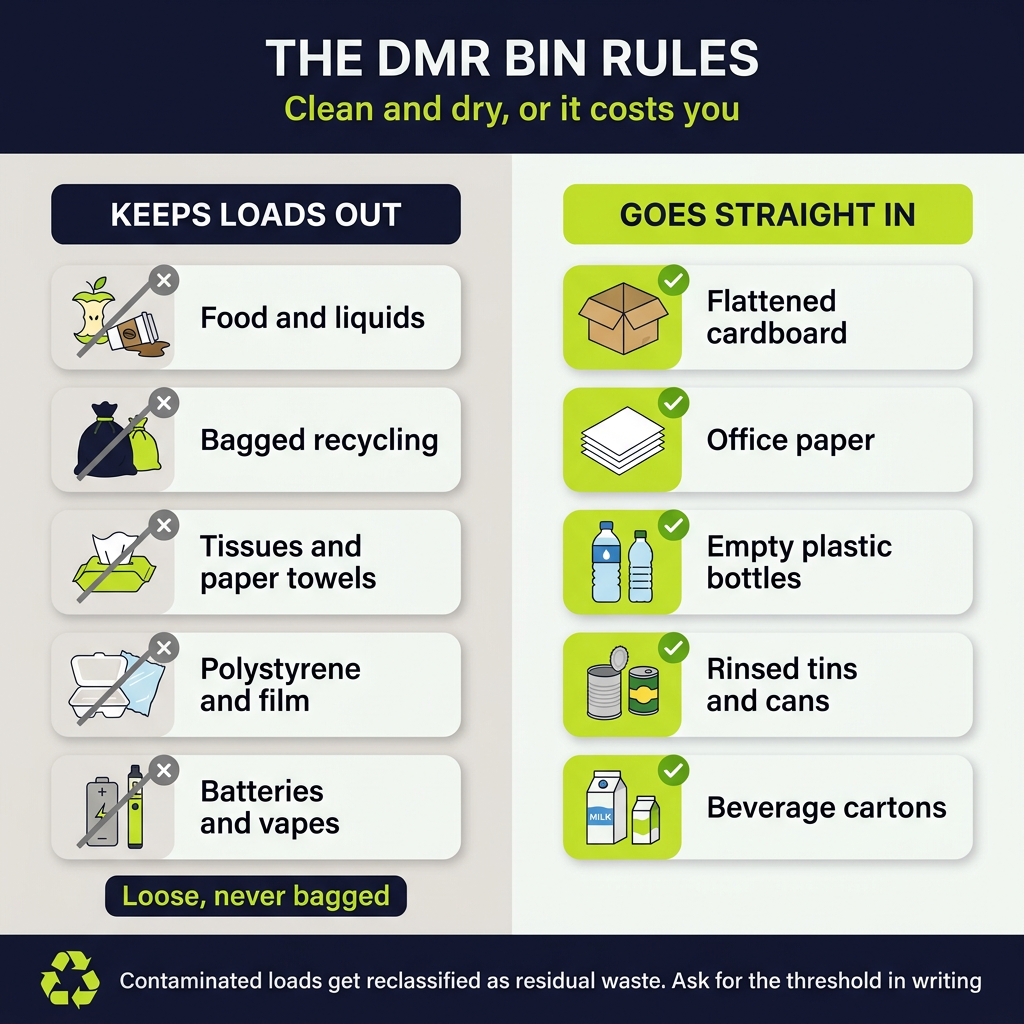
- Cardboard and corrugated packaging, flattened
- Office paper, newspapers, magazines and brochures
- Plastic bottles, empty and rinsed
- Food and drink tins and aluminium cans, empty and rinsed
- Rigid plastic tubs and trays, empty and rinsed
- Beverage cartons
Empty and reasonably clean is the standard. It does not mean washing up. It means tipping out the dregs and giving it a quick rinse if it held anything greasy or sugary.
What keeps loads out, in even plainer English
These are the items that cause the most rejected loads in commercial premises:
- Food waste of any kind. Food is the single biggest contaminant in DMR. It is also the one that spreads, because liquid and grease travel through paper.
- Liquids. Half a coffee is enough to ruin the paper around it.
- Bags. Dry mixed recycling goes in loose. Material presented in a bin bag is frequently refused outright, because the sorting line cannot open bags safely or reliably.
- Tissues, paper towels and hand towels. They are paper, but the fibres are too short to recycle, and they are usually contaminated.
- Polystyrene and soft plastic film. Neither is accepted in standard DMR.
- Batteries and small electricals. These are a fire risk on a sorting line, not just a contaminant.
- Glass. Many commercial DMR streams exclude glass entirely, because broken glass embeds itself in paper and card. Check yours.
- Hazardous items, aerosols and chemical containers. These need a separate stream.
The bag rule is the one that catches most businesses out, because it feels wrong. Cleaning teams bag everything by habit. If your recycling is going out in black or clear sacks inside the wheelie bin, that is worth fixing this week.
How contamination actually reaches your invoice
Contamination is not a single charge. It shows up in three different ways, and knowing which one you are being billed for matters.
A contamination charge. Some contracts carry a fixed fee when a load exceeds a stated contamination threshold. It should be defined in your contract as a percentage.
A reclassification. The load stops being recycling and becomes residual waste. You then pay the residual rate for the whole collection, which is typically several times higher, plus any handling difference.
A rejected load. In serious cases, the facility refuses the material entirely. It is redirected to energy from waste or landfill, and the cost of that diversion comes back down the chain.
Ask your provider which of these applies to you, what the contamination threshold is, and whether you get photographic evidence when a load is flagged. Reputable operators photograph contaminated loads at the point of tipping. If yours does not, you have no way to check a charge you are asked to pay.
Why this is about to matter more than it does today
Simpler Recycling has already changed the rules for larger workplaces in England. Businesses with ten or more full-time equivalent staff have been required to separate dry recyclables, food waste and residual waste since 31-03-2025.
Micro-firms, meaning those under ten full-time equivalent employees across the whole business rather than per site, have until 31-03-2027. That headcount is calculated across the entire business. Volunteers, contractors and the self-employed do not count towards it.
That deadline is closer than it looks. If you are going to be running separate collections from 2027 anyway, getting DMR clean now is the cheap version of the same job. Our Simpler Recycling guide covers what changes and when.
Five practical fixes that cut contamination fast
None of these needs a budget. All of them work.
Put the bin where the waste is made. The single biggest cause of contamination is distance. If the recycling bin is thirty feet from the desk and the general bin is under it, you already know what happens.
Pair every recycling bin with a residual bin. A recycling bin on its own becomes a general bin by lunchtime. They must exist in pairs, always.
Use pictures, not words. Photographs of the actual items your business produces beat any printed list. A photo of your own coffee cup lid is worth more than a paragraph of guidance.
Solve the food problem separately. If your team eats on site, you need a food waste bin. Without one, food goes in whichever bin is nearest, and that is often the recycling.
Brief the cleaning team, not just the staff. Cleaners move the waste once everyone has gone home. If they are consolidating everything into bags, nothing your staff do during the day will survive.
Frequently asked questions
What is dry mixed recycling?
Dry mixed recycling is a single commercial waste stream that combines clean, dry recyclable materials, typically paper, cardboard, plastic bottles, tins and cans, in one bin. The materials are separated later at a sorting facility rather than at your premises. It is usually the cheapest waste stream a business can use, because the material has a recovery value.
Can I put recycling in bags in a DMR bin?
Usually not. Most sorting facilities require dry mixed recycling to be presented loose, because bagged material cannot be opened and sorted safely on a mechanical line. Bagged recycling is one of the most common reasons a commercial load is refused. Check your provider’s rules, but assume loose unless told otherwise.
Does cardboard need to be clean to be recycled?
It needs to be dry and free of food residue. Grease and moisture break down the fibres and make the card unusable, which is why pizza boxes and takeaway packaging are rejected. Dry, flattened cardboard is one of the most valuable materials in the stream. Wet cardboard is worthless.
How much can contamination cost my business?
It depends on your contract, but the mechanism is what matters. A contaminated load is typically reclassified as residual waste, which usually carries a materially higher gate fee than recycling, and some contracts add a separate contamination charge on top. Ask your provider for the contamination threshold and the charge in writing.
Does glass go in dry mixed recycling?
Often not. Many commercial DMR streams exclude glass because broken glass contaminates paper and card and damages sorting equipment. Businesses producing meaningful volumes of glass, particularly pubs, bars and restaurants, are usually better served by a dedicated glass collection.
The bottom line
Dry mixed recycling saves money right up until the moment it does not. The gap between a clean load and a rejected one is almost never a policy problem. It is a bin placement problem, a bag problem, or a food problem.
Fix those three, and DMR does exactly what it is supposed to do.
Priority Waste runs dry mixed recycling collections for businesses across the UK from our Bedford base, with clear contamination reporting and no guesswork on what goes in the bin. Book a free waste review, and we will look at your bin placement, your volumes and your contamination risk before quoting.

