
You open the gates on Monday and there it is.
A heap of black sacks, a broken sofa and a stack of plasterboard sit by your loading bay. None of it came from your business.
It still sits on your property, and until it goes, it remains your problem to resolve.
Who pays when it lands on your land
On public land, the local authority generally clears fly tipping. On private land, the picture changes considerably.
In most cases the landowner or occupier is left to clear it and pay for it. That can mean you, your landlord, or both, depending on the lease.
Check with your council first. Rules and support vary between areas. Some councils offer help or advice, and some will investigate even on private land.
Check the lease too. It may say who handles the yard, the car park and the shared areas.
Industrial estates with a management company may have their own procedure. Ask the estate manager how they handle dumped waste on common roads.
None of this feels fair. You did not dump it, and you still carry the cost. The best you can do is clear it properly, record it well and make your site a harder target.
Look before you touch anything
Most dumped piles are ordinary waste. Some are not, and you cannot always tell by looking.
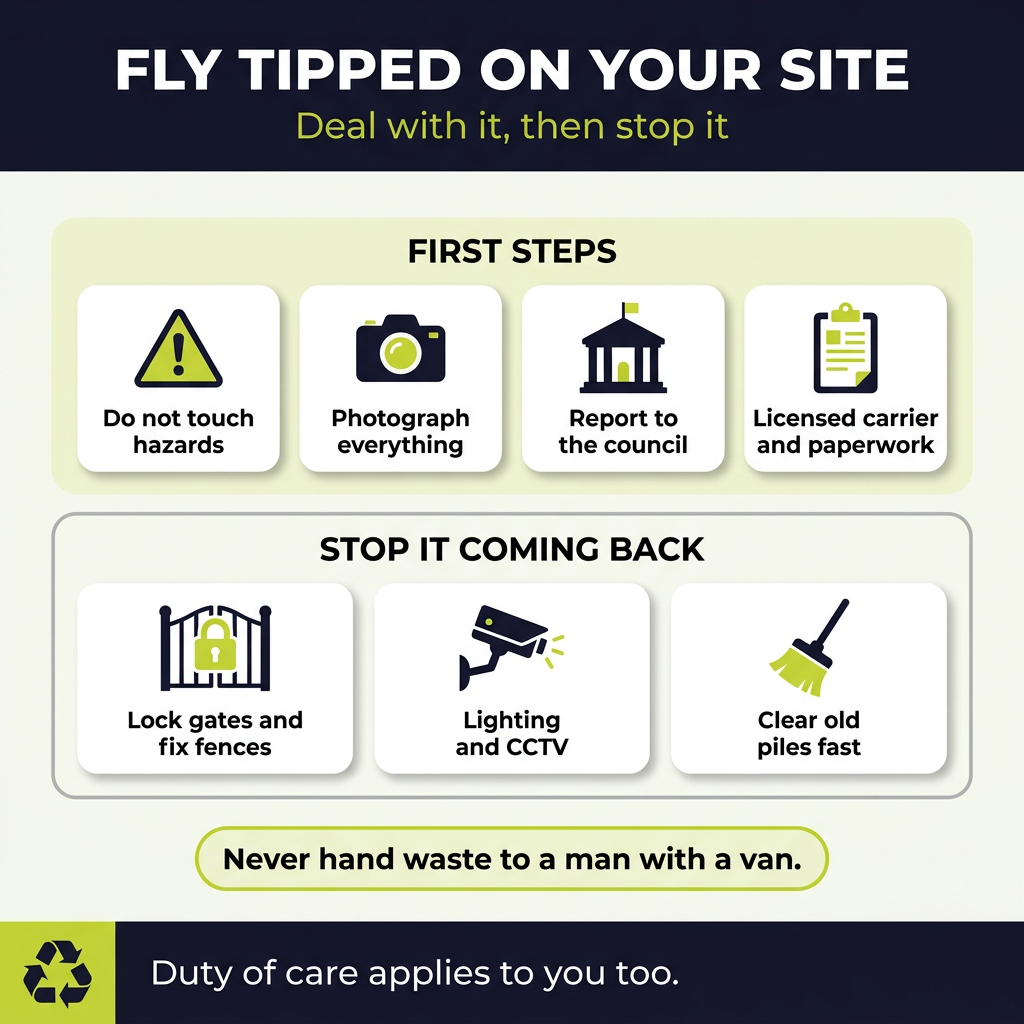
Do not touch suspicious items. That means broken sheets that might be asbestos, unlabelled drums, gas bottles, chemical tubs and anything with needles in it.
Keep staff and visitors away from them, and cone off the surrounding area if you can. Do not open, move or crush anything you are unsure of.
Hazardous material needs a specialist route, not a general clearance. Asbestos in particular needs a licensed contractor, and the council may want to know about it.
Needles and sharps need the same care. Our clinical waste service covers sharps that turn up where they should not.
Dumped asbestos is a serious offence for the person who tipped it. One case, a Devon man sentenced to 32 months, shows how seriously courts take it.
Record it, then report it
Before anything moves, build a detailed record. It helps the council, your insurance company and any later investigation.
Photograph everything. Take wide shots showing where the pile sits, then close ups of each item.
Look for anything with a name or address on it. Letters, delivery labels and invoices sometimes end up in dumped sacks. Photograph them, but do not sort through the waste by hand.
Note the date and time you found it. Check your CCTV and note any vehicles or times that look relevant.
Write down when the site was last clear. That narrows the window for anyone looking into it.
Report it to the council. Most have an online form for fly tipping. Give them the photos, the location and any evidence you found.
Keep a copy of the report and any reference number. If it happens again, you will want the history.
Tell your insurer as well. Some commercial policies include cover for removal costs, so read the policy wording before you book a collection.
Clear it with a licensed carrier
Once you have recorded and reported it, the waste still needs to go. How it goes matters.
Duty of care applies to you too. When you hand waste to someone else, you must check they hold a licence to carry it. Our guide to duty of care for UK businesses explains what that means.
Use a registered waste carrier, and check their licence on the public register before they load anything.
Keep the paperwork. A waste transfer note should describe the waste, show where it went and name who took it.
File the note with your photos and the council report. Together they show you dealt with it properly.
For a one off pile, a commercial site clearance often works best. For mixed loads, our guide to skips, bins or a clearance crew helps you pick the right service.
Never hand it to a man with a van
This is where a bad week can turn into a worse one.
A cheap cash offer to take the lot can feel like a relief. Somebody knocks on the door, names a low figure and promises it will be gone by lunch.
If someone tips that waste again, it can trace back to you. You were the last legal holder, and you did not check who took it.
The same rule covers your own waste. Old pallets, office clear outs and broken racking all need a licensed carrier and a transfer note.
Unlicensed collectors cut costs by dumping. Their next stop might be somebody else’s yard, with your paperwork in the pile.
Our guide to brokers and contractors explains who you are dealing with. Our checklist on choosing a waste supplier covers the questions to ask.
Make your site a harder target
Fly tippers look for easy access, minimal risk of identification and a location where another pile will not stand out.
Close the gaps. Lock gates out of hours. Fix broken fencing and block open verges with planters or barriers.
Light the yard and the entrance. Dark corners near a road attract dumping.
Height barriers on car park entrances stop vans and tipper lorries driving straight in. They suit sites where staff and visitors arrive by car.
Fit CCTV that covers the entrance and the spots where waste has landed before. Make sure it records number plates clearly.
Put up clear signs. Say that cameras cover the area and that you report every incident.
Clear old piles fast. A small heap left for weeks tells people the site is a dumping ground. More arrives on top.
Keep your own bins tidy as well. Overflowing containers make the whole yard look like a tip, and other people add to it.
When it keeps happening
One incident is bad luck. Several in a month is a pattern that needs a different approach.
Track every incident. Note the date, the time window, the type of waste and where it landed.
Look for the common thread. The same corner, the same day of the week or the same type of waste all tell you something.
Trade waste such as rubble and plasterboard points to a builder or cheap clearance outfit. Household goods point to someone using your yard instead of a tip.
Share the log with the council. A clear pattern gives them more to work with than a single report.
Persistent incidents may justify a conversation with the police or the environmental enforcement team. Vehicle registrations on camera give them a genuine lead.
Talk to the neighbouring businesses. They may face the same problem and could share CCTV footage or the cost of a better gate.
Review your security after each incident. If the same gap keeps getting used, close it properly rather than clearing up again.
Frequently asked questions
Who pays to clear fly tipping on business property?
On private land, the landowner or occupier is usually left to clear it. Check with your council and your lease for the rules in your area.
Should I move the waste myself?
Only if it is clearly ordinary waste and safe to handle. Never touch possible asbestos, drums, chemicals or needles.
How do I report fly tipping?
Use your council’s online fly tipping form or call them. Include photos, the location and any names or addresses you saw.
Can I be fined for waste that someone else dumped?
Rules vary, so check with the relevant authority. You do need to clear it properly and use a licensed carrier.
What paperwork should I keep?
Keep your photos, the council report reference and the waste transfer note from the carrier who removed it.
How do I stop fly tipping on my site?
Lock gates, add lighting and CCTV, put up signs and clear any old piles quickly.
The bottom line
Fly tipping on your land is unfair, and it usually lands on you to fix.
Stay clear of anything hazardous, photograph the lot and report it to the council.
Clear it with a licensed carrier and keep the paperwork, because duty of care still applies.
Then close the gaps, log every incident and never let a cash collector near your waste.
Priority Waste provides site clearances and waste collections across the UK, with full paperwork on every job. Book a free waste review, and we will start with the corner of the yard where it keeps landing.

