
Almost every waste stream your business produces is a cost. You pay to have it collected, you pay a gate fee, and you pay again for the paperwork.
Metal is the exception. Handled properly, metal is the one stream that can send money back the other way.
Handled carelessly, it becomes the most expensive thing in your general waste bin, because you are paying by weight to dispose of a material somebody would have paid you to take away.
Why metal is different from everything else in your yard
Metal has a commodity value that never disappears. Steel, aluminium, copper and brass can be melted down and re-formed indefinitely without losing their structural properties. That is not true of paper, which loses fibre length every cycle, and it is not true of most plastics.
Because the material retains its value, the economics reverse. Recyclers compete to buy it. That competition is what creates a rebate.
The size of that rebate depends on three things: what the metal is, how clean it is, and how much of it you have in one place.
Ferrous and non-ferrous, and why the gap is enormous
The first split in the metals world is magnetic.
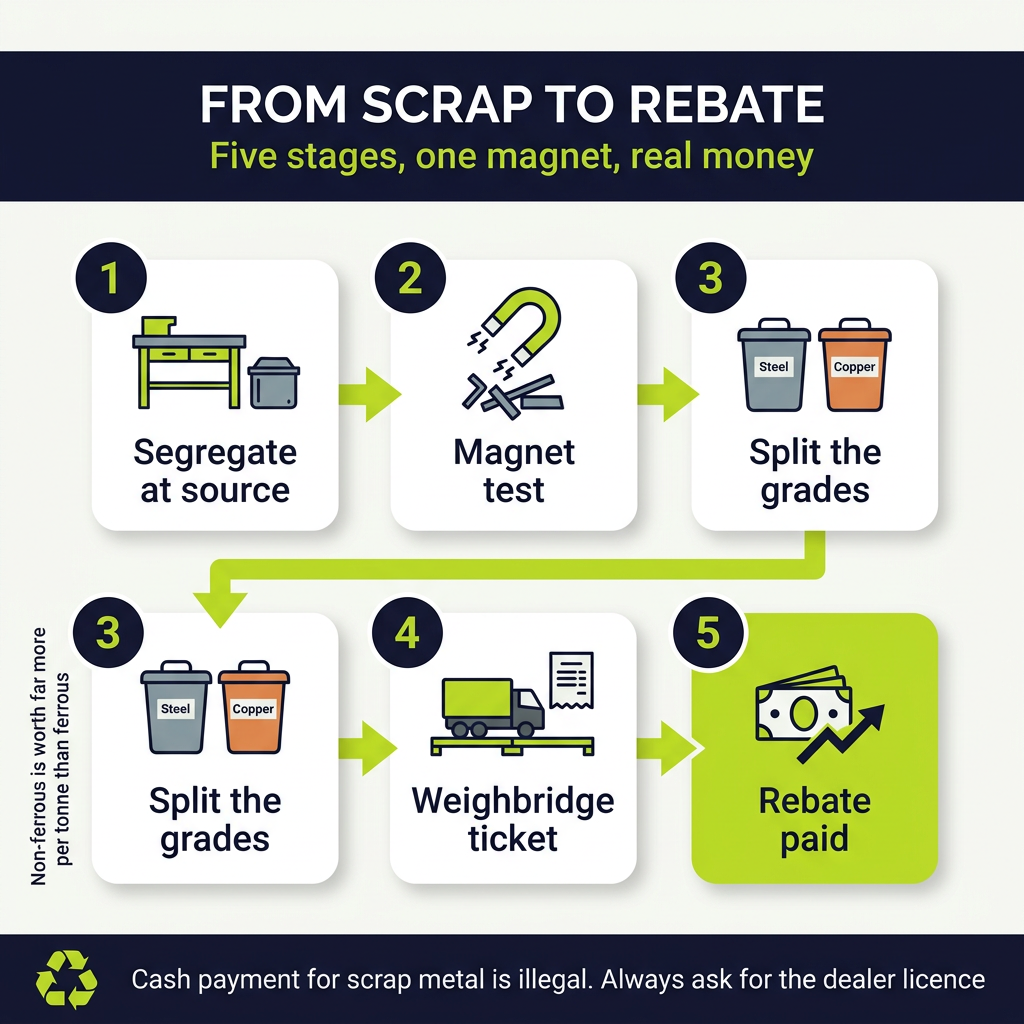
Ferrous metals contain iron. Steel, cast iron and most structural metal sit here. A magnet sticks to them. They are the most common metals in commercial waste, and they carry the lowest per-tonne value, because they are abundant.
Non-ferrous metals do not contain iron and are not magnetic. Copper, aluminium, brass, lead, zinc and stainless steel sit here. They are worth substantially more per tonne, in some cases by an order of magnitude.
The practical consequence is simple and expensive. If your non-ferrous metal is mixed into a general scrap skip, it is priced as the lowest-value material in that skip. Copper cable thrown in with structural steel is paid for as steel.
A magnet costs almost nothing. It is the highest-return piece of equipment on most industrial sites.
What actually drives the price you are offered
Rebate quotes vary far more than most buyers expect, and the reasons are consistent.
Grade. Recyclers work to defined grades, not to general descriptions. Clean, single-grade material commands the best price. Mixed material is graded down to its worst component.
Contamination. Plastic coating, rubber, timber, concrete and attached fixings all reduce value. Insulated copper cable is worth meaningfully less than bright bare copper, because the recycler has to strip it. That stripping cost comes out of your rebate.
Volume and consistency. A predictable monthly tonnage is worth more per tonne than an occasional one-off. Recyclers price for reliability of supply, not just quantity.
Market timing. Metal is a traded commodity. Prices move weekly. Any rebate quoted to you months in advance without a mechanism for market movement should be treated with suspicion.
Collection logistics. Whether you need a lorry with a crane, whether the material needs cutting to size, and how far the site is from the processing facility all get priced in.
The paperwork nobody mentions until it goes wrong
Metal recycling carries a legal regime that other waste streams do not, and it exists because of metal theft.
Under the Scrap Metal Dealers Act 2013, any business buying or dealing in scrap metal in England and Wales must hold a licence from the local authority. There are two types, a site licence and a mobile collector’s licence.
The Act also bans cash payments for scrap metal. Payment must be by cheque or electronic transfer, and the dealer must keep records that identify the seller. If somebody offers to take your metal away and pay you in cash, they are breaking the law, and you are handing controlled waste to an unlicensed operator.
That matters for you, not just for them. Your duty of care under the Environmental Protection Act 1990 does not disappear because someone offered you money. You still need to check the licence, and you still need waste transfer documentation.
Ask for three things before any metal leaves your site: the scrap metal dealer licence, the waste carrier registration, and a waste transfer note. A legitimate operator produces all three without hesitation.
Where businesses find metal they did not know they had
Metal accumulates in places that are not the obvious ones. If you have never done a proper sweep, these are the usual finds:
- Redundant plant and machinery sitting in a corner of the workshop because nobody had a plan for it
- Racking and shelving from a warehouse reconfiguration
- Cable offcuts and armoured cable from any electrical work, which are non-ferrous and often the most valuable thing on site
- Catering equipment, which is usually stainless steel
- Vehicle parts, tooling and jigs that have been superseded
- Structural offcuts from fabrication, which are the easiest to segregate at source because they are produced in one place
- Old bins, cages and stillages
The other reliable source is a site clearance. When a business closes, moves or strips out a unit, the metal content is frequently high enough to offset a meaningful share of the clearance cost. Our guide to clearing a commercial site covers how that offset works in practice.
Making it work without changing how anybody does their job
The businesses that get real money back from metal do the same four things.
Segregate at the point of production. A separate container next to the machine or bench that makes the offcuts. Not a container in the yard that people have to walk to.
Split ferrous from non-ferrous with a magnet. One extra container, one simple test, and a large price difference.
Keep cable separate and uncut. Do not let anyone burn insulation off cable. It is illegal, it is dangerous, and it damages the copper.
Weigh and record everything. Ask for weighbridge tickets on every collection. Without them, you cannot check the rebate calculation, and you cannot see when your volumes change.
Frequently asked questions
Can my business get paid for scrap metal?
Yes. Metal is one of the few waste streams with a positive commodity value, so recyclers pay for it rather than charging for its removal. Whether you receive a rebate depends on the type of metal, how clean and well segregated it is, and the volume you produce. Small mixed quantities may simply offset the collection cost rather than generating a payment.
What is the difference between ferrous and non-ferrous metal?
Ferrous metals contain iron and are magnetic. Steel and cast iron are the main examples. Non-ferrous metals contain no iron and are not magnetic, including copper, aluminium, brass, lead and stainless steel. Non-ferrous metals are worth considerably more per tonne, which is why separating the two is the single most valuable thing a business can do with its metal waste.
Is it legal to be paid in cash for scrap metal?
No. The Scrap Metal Dealers Act 2013 prohibits cash payments for scrap metal in England and Wales. Payment must be made by cheque or electronic transfer, and the dealer must record the seller’s identity. Any operator offering cash is operating outside the law, which puts your duty of care compliance at risk as well as theirs.
What paperwork do I need when metal leaves my site?
You need a waste transfer note for the movement, and you should check that the operator holds both a valid waste carrier registration and a scrap metal dealer licence issued by their local authority. Keep weighbridge tickets too, since they are the only way to verify the tonnage your rebate is calculated on.
How often do scrap metal prices change?
Metal is traded as a commodity, so prices move continuously and can shift noticeably within a month. Any rebate arrangement should state how it tracks the market, whether that is a monthly reset or a link to a published index. A fixed price quoted far in advance is either generous to you or, more often, generous to the buyer.
The bottom line
Metal is the one line on your waste report that can be a credit rather than a charge. Getting it there is not complicated. It is a magnet, a second container, and asking for the weighbridge ticket.
The businesses that skip those three steps are not making a small mistake. They are paying by the tonne to throw away something with a market price.
Priority Waste collects ferrous and non-ferrous metal for businesses nationally from our Bedford base, with weighbridge tickets on every load and full waste transfer documentation. Book a free waste review and we will tell you what your metal is actually worth.

