
Ask a factory manager about food waste, and you will get a puzzled look. There is no kitchen.
There is a canteen, a vending area, a staff room with a fridge, and a bin under every desk. There is also a batch of product that failed spec last Tuesday.
Food waste is not a hospitality stream. It is a stream that hospitality happens to produce visibly, while everyone else produces it quietly.
The sites that produce more than they admit
Our hospitality guide covers restaurants and pubs. This list is everybody else.
- Care homes, where three meals a day for every resident adds up fast
- Schools, colleges and nurseries, with plate scrapings at a fixed daily peak
- Hospitals, clinics and hospices
- Offices with a canteen, a coffee point or a regular lunch delivery
- Food manufacturers, with trimmings, failed batches and out-of-date raw material
- Supermarkets, convenience stores and farm shops
- Warehouses and distribution centres handling chilled goods
- Prisons, barracks and other catered residential sites
- Event venues, stadiums and conference centres
If people eat on your premises, you produce food waste. The only question is which bin it currently lands in.
Why it does not belong in general waste
Three separate reasons, and any one of them would be enough.
It is heavy and wet. Food is mostly water, and general waste bills follow weight. You pay a premium rate for liquid.
Separate collection is now the rule. English workplaces must present food waste in its own container rather than mixed into the black bin.
It has a genuinely better route. Separated food waste goes to anaerobic digestion or composting, which produces energy and soil improver rather than landfill gas.
Our food waste service covers the collection side of all three.
What happens to it after collection
Worth knowing, because it explains the rules about what can go in the bin.
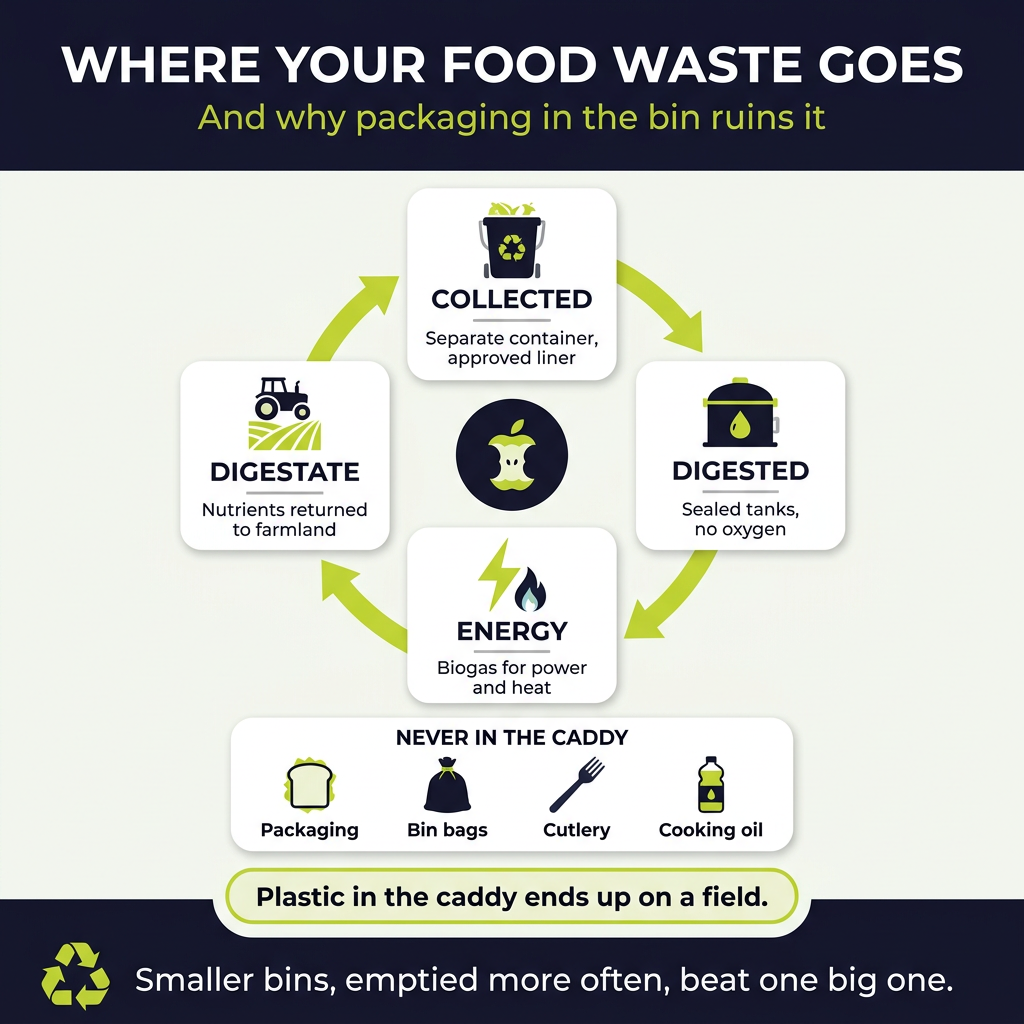
Anaerobic digestion is the main route. Sealed tanks, no oxygen, bacteria breaking the material down.
It produces biogas. That gas generates electricity or goes into the gas grid.
The residue becomes digestate. A nutrient-rich material used on farmland as a fertiliser.
Which is why contamination matters so much. Plastic and packaging in that stream end up spread on a field.
That last point is the reason food waste bins are fussier than people expect.
What ruins a food waste load
The list is short, and staff break it in good faith almost every time.
Packaging. A sandwich still in its wrapper is packaging waste, not food waste. The same goes for yoghurt pots and crisp packets.
Plastic liners. Only compostable or approved liners belong in the bin. An ordinary bin bag fails the process.
Cutlery and crockery. Plastic forks are the single most common contaminant in a canteen.
Cooking oil. Used oil is a separate stream with a separate route, and often a rebate.
Anything that is not food. Cleaning wipes, gloves, paper towels and coffee cups all fail here.
Packaged food is a different job. Depackaging exists for that, and it needs booking as such.
The bins are smaller than you think, for good reason
Managers often ask for a large container, then blink at what arrives.
Food waste is dense. A 240 litre bin of food is very heavy, and often too heavy to move safely.
Smaller and more frequent beats large and occasional. Especially in summer.
Caddies feed the main bin. Small kitchen caddies are emptied often into a lockable outer container.
Lids matter more here than anywhere. Odour, flies and vermin all begin with an open lid.
Site the outer bin away from doors and air intakes, and in shade where you have a choice.
Care homes and schools have a timing problem
Both produce food waste on a clock, and both have a reason to move it off site fast.
Volumes peak at fixed times. Three services a day in a care home, one big lunch peak in a school.
Holidays change everything for schools. A schedule that fits term time burns money over six weeks of summer.
Infection control matters in care settings. Waste routes and storage need to work for the site’s own controls.
Bins need locks. Open access causes trouble when residents or children share the grounds.
Weekends differ too. A care home runs seven days. A school runs five, and a sixth if the hall is hired out.
Tell us the calendar as well as the volume. A suspended holiday schedule usually costs less than paying through the break.
Manufacturers have a different problem entirely
Production waste is not plate scrapings, and it does not behave the same way.
Volumes are large and predictable. Trimmings and offcuts arrive at a steady rate.
Failed batches arrive all at once. A single rejection can fill a container in an hour.
Packaged product needs depackaging. Sealed stock cannot go straight to digestion.
Some material is category controlled. Animal by-products have their own rules and their own routes.
Say what the material is, and say whether it arrives packaged. Both change the destination.
Volumes here justify their own container sizes. A production line rarely fits the bins that suit a staff canteen.
Getting staff to use it properly
Food waste separation succeeds or fails in the first fortnight.
Put a caddy where staff handle food. The prep bench, the servery, the coffee point.
Take the general bin away from that spot. If a black bin is closer, the black bin wins.
Use pictures on the label. A photograph of a sandwich wrapper with a cross through it beats a paragraph.
Brief cleaners and agency staff. Most contamination arrives with people who never saw the induction.
Our guide to separated collections for workplaces covers the wider bin set-up.
Frequently asked questions
Do non-catering businesses have to separate food waste?
If people eat on the premises, you produce food waste. English workplaces must now present it in its own container.
That covers offices with a canteen or a coffee point, not only restaurants and pubs.
Can packaged food go in the food waste bin?
No. A wrapped sandwich or a sealed yoghurt is packaging waste with food inside it.
Packaged stock needs depackaging, which is a separate service. Tell us the quantity, and we will find the right route.
What bin liners can we use?
Only compostable or approved liners. An ordinary plastic bin bag contaminates the load, and the whole load can fail.
Caddy liners are cheap, and using the wrong ones defeats the whole exercise.
What happens to collected food waste?
Most goes to anaerobic digestion. That produces biogas for electricity or the gas grid, plus digestate for farmland.
That end use is why plastic in the bin matters so much.
How often should food waste be collected?
More often than general waste, and more often in summer. Food is dense, and it degrades, so smaller containers emptied frequently work better than large ones.
Schools should ask about suspending collections over the holidays.
Does used cooking oil go in the same bin?
No. Used cooking oil is a separate stream with its own container and its own route.
It often carries a rebate rather than a charge, so it is worth asking about separately.
How do we stop the bin smelling?
Keep lids closed and site the container in shade, away from doors. Collect often enough that nothing sits for a week.
Wash the outer bin now and then, and use caddy liners so the caddies themselves stay usable.
The bottom line
Food waste is a general waste cost pretending to be a kitchen issue. It is heavy, it is wet, and you are paying a disposal rate for water.
Put caddies where food is handled and move the black bin away from them.
Use approved liners, keep packaging out, and collect more often in summer than in winter.
Then tell us your calendar. A schedule built for term time or peak season is wrong for half the year.
Priority Waste provides commercial food waste collection across the UK, including depackaging for sealed stock. We work with care homes, schools, offices and manufacturers.
Book a free waste review, and we will work out what is going into your general bin today.

