
Every business that makes or sells things ends up with stock it cannot sell.
A failed batch. A discontinued line. Four pallets in packaging that carries the old logo.
It is worth nothing on the balance sheet, and it is occupying a bay. So somebody finds a clearance buyer, and the problem appears to go away.
Then it turns up on a market stall eighteen months later, still carrying your name.
Written off is not the same as gone
This is the gap that catches companies out, and it is a commercial gap rather than a legal one.
Writing stock off is an accounting decision. It removes the value from your books and nothing else.
Disposal is a logistics decision. It moves the pallet off your site.
Destruction is neither. It is a controlled process that ends with the product no longer existing in a sellable form.
A clearance broker who quotes you a good price is not destroying anything. They are reselling it, which is the outcome you wanted to avoid.
What businesses need destroyed
The category is wider than most people picture, and it is rarely dramatic.
- Failed or out-of-specification production batches
- Discontinued, rebranded and relabelled lines
- Seasonal and promotional overstock
- Customer returns in unsellable condition
- Recalled product
- Counterfeit goods seized or intercepted
- Damaged stock from a warehouse or transit incident
- Expired and short-dated goods
- Prototypes, samples and trial runs
- Uniforms, branded workwear and signage from a rebrand
That last one catches people. Branded uniform in a charity bag ends up on somebody who does not work for you.
Why diversion is the risk that actually bites
Most businesses worry about disposal cost. The expensive failure is somewhere else entirely.
Grey market resale undercuts your own pricing. Your product competes with itself, at a price you never set.
You carry the liability for a product you rejected. A failed batch still has your details on it, and a consumer complaint follows those details.
Recalled goods reappearing is a story you cannot control. It is a regulator conversation as well as a press one.
Licensing agreements often demand it. Many brand and distribution contracts oblige you to evidence destruction rather than disposal.
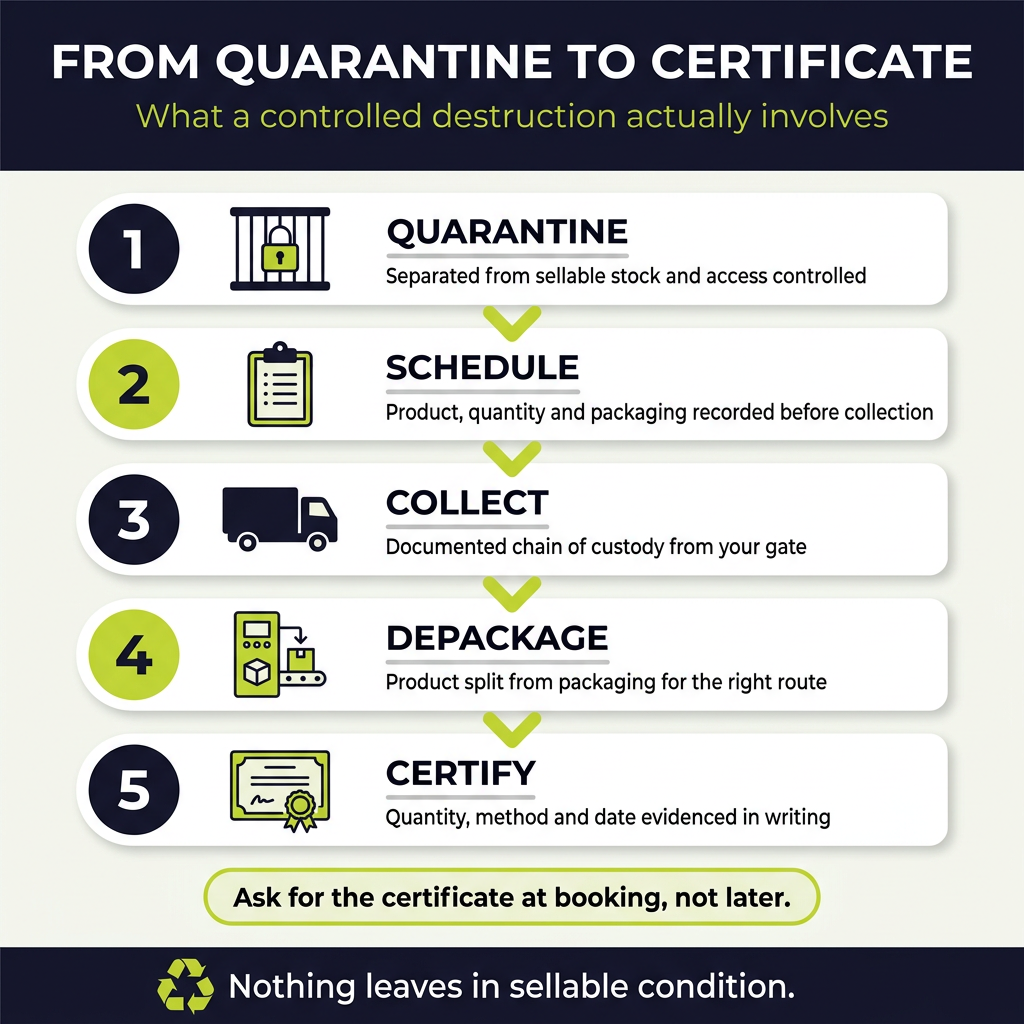
The chain of custody is the whole product here. Ask any provider how they stop intact stock from leaving.
What a certificate of destruction is for
The certificate is the document that closes the loop, and it earns its keep in four different rooms.
It records what the process destroyed. Quantity, product, date, method and who carried it out.
Finance uses it to support the write-off. An auditor prefers a third-party certificate to an internal note.
Brand and legal teams use it for licensing. It appears as a contractual requirement far more often than people expect.
Compliance files it with the waste paperwork. It sits alongside your waste transfer notes, not instead of them.
Ask for it at the point of booking. Retrieving one month later is always harder than requesting it up front.
Read what it covers, too. A certificate that names a pallet count and no product detail will not satisfy a brand auditor.
What actually happens to the material
Destruction does not mean landfill, and for most products it should not.
Depackaging separates product from packaging. Each part then takes the route that suits it.
Packaging recovers. Card, rigid plastic, glass, and metal go for recycling where the process allows.
Product takes the correct treatment route. Often energy recovery, sometimes specialist treatment depending on the material.
Nothing leaves in sellable condition. That is the point of the exercise, and it is what separates this from clearance.
Our product destruction service covers the whole chain, from collection to certificate.
Witnessed destruction, and when to ask for it
Some jobs need somebody from your side present. Most do not.
High-value and licensed goods usually do. Where a contract requires witnessed destruction, arrange it at booking.
Counterfeit and seized goods often do. There may be a legal process attached that sets its own requirements.
Recalls sometimes do. It depends on the regulator and the product category.
Routine obsolete stock usually does not. A certificate and a documented chain of custody are normally enough.
Deciding this early is the difference between a scheduled visit and a rearranged one.
It also decides who needs to be free that morning. Witnessed destruction ties up somebody senior for half a day.
The information that goes in the paper
This is a document-heavy job, and vague instructions produce vague certificates.
Describe the product properly. Names, codes, batch numbers where they exist.
Count in pallets and units. Pallets for logistics, units for the certificate.
Say what the packaging is. Glass, aerosol, rigid plastic and card all affect the route.
Flag anything under recall. It changes both urgency and documentation.
Name who signs. Somebody on site has to sign the transfer paperwork on the day.
A certificate can only be as specific as the instruction behind it.
Where this overlaps with confidential waste
The two jobs are cousins, and they often arrive on the same site at the same time.
Documents, drives and media follow the shredding route. We covered that in our guide to the bin as a data breach.
Branded goods and stock follow the destruction route described here.
A rebrand produces both at once. Old letterhead, signage, uniform and packaging all leave in the same week.
One provider can take both. Two providers mean two chains of custody and two sets of paperwork.
Ask for one collection covering both wherever the timing allows.
It keeps the evidence together as well. One provider means one file to produce when somebody asks for it.
Frequently asked questions
What is the difference between product destruction and disposal?
Disposal moves waste off your site. Destruction is a controlled process that leaves the product in no sellable form, evidenced by a certificate.
Clearance is a third thing entirely, because clearance means somebody else sells it.
What does a certificate of destruction prove?
It records the quantity destroyed, the product, the date, the method and who carried it out.
It supports a write-off for finance and satisfies licensing and brand obligations. It then sits in the compliance file with your waste transfer notes.
Can we watch the destruction happen?
Yes, and some contracts require it. Witnessed destruction is normal for high-value, licensed and counterfeit goods.
Arrange it when you book rather than on the day, because it affects scheduling.
Is destroyed stock recycled or landfilled?
Depackaging separates product from packaging, and the packaging goes for recycling wherever the material allows.
The product itself takes the correct treatment route, which is frequently energy recovery rather than landfill.
We have a recall. How should we handle it?
Say it is a recall at first contact, because it changes the priority and the paperwork.
Keep the stock quarantined and access controlled while it waits, and ask for the certificate up front.
Do we need destruction for branded uniform and signage?
If you would not want a member of the public wearing or displaying it, then yes.
A rebrand usually produces uniform, signage, packaging and documents together, and they can go on one collection.
Who is responsible if written-off stock is resold?
The product still carries your brand and your responsible person details, so the exposure comes back to you.
That is the reason to evidence destruction rather than accept a clearance price.
The bottom line
Obsolete stock is two problems in one pallet. One is a disposal cost, and the other is your brand walking out of the gate intact.
Clearance solves the first and creates the second. Destruction solves both.
Ask for the certificate at booking. Quarantine the stock behind a lock while it waits, and decide early whether it needs witnessing.
Then send the documents and the branded goods on one collection. Two chains of custody are always harder to evidence than one.
Priority Waste provides secure product destruction for manufacturers, brands and distributors across the UK. Witnessed destruction is available, and every job carries a certificate. Book a free waste review, and we will look at what is sitting in the quarantine bay.

