
Walk behind a busy pub on a Sunday morning and look in the general waste bin.
Somewhere under the kitchen bags, there will be glass. Not a few stray bottles, but a Saturday night’s worth of them.
That bin is now the heaviest thing on site. And your general waste bill follows the scales.
Why glass punishes you harder than anything else
Glass is dense. A wheeled bin of bottles weighs many times what the same bin of cardboard weighs.
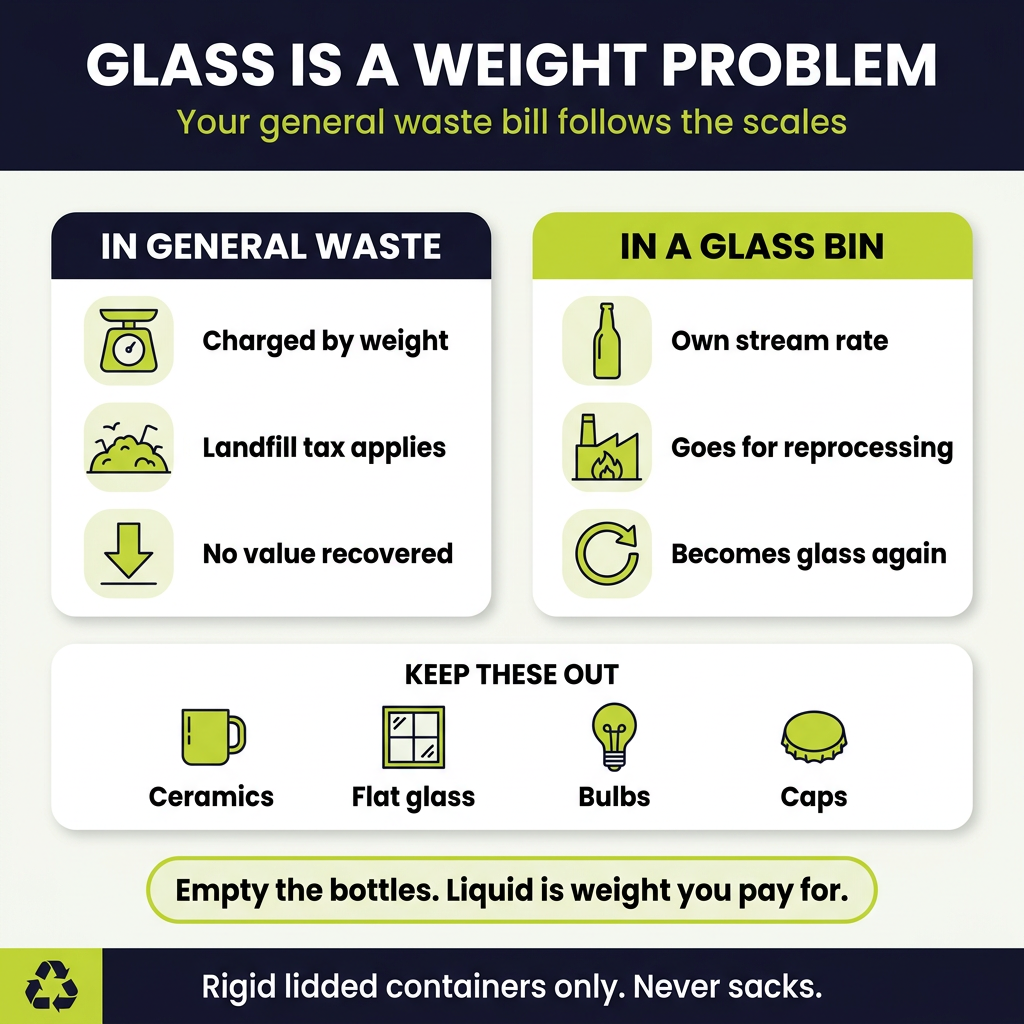
General waste bills follow weight. Lift charges, tonnage rates and landfill tax all follow the scales. Glass loads every one of them.
Recycled glass sits at a different rate. It goes for reprocessing rather than disposal, and it avoids landfill tax altogether.
So the same bottle costs you twice. Once as expensive general waste, and once as the cheaper recycling you never claimed.
That is the whole argument. It is not a green argument, though the green case is real too.
The businesses that produce more than they think
Hospitality is obvious. The rest of this list surprises people.
- Pubs, bars and nightclubs, where the volume is highest per square metre
- Restaurants, cafes and hotels, with wine, spirits and table water
- Contract caterers and staff canteens
- Event venues, stadiums and conference centres
- Food producers, with jars, sauce bottles and rejected stock
- Laboratories and clinics, with sample and reagent glass
- Cosmetics and fragrance manufacturers, with bottles and testers
- Offices with a stocked bar or a regular client hospitality run
If glass leaves your building in any quantity, it belongs in its own stream. Our glass recycling service exists for that job.
Colour separation, and when it actually matters
Glass recycling splits into two approaches, and your site will suit one of them.
Mixed colour collection takes everything in one container. It is simpler for staff, and it fits tight backyards.
Colour-separated collection splits into clear, green and brown. Clear glass is the valuable one, because it can become clear glass again.
Mixing colours downgrades the material. Let green bottles into the clear bin and the whole load becomes green. That closes off the higher value route.
Larger producers separate. Smaller sites do not. Tell us your volumes, and we will say which one earns its keep.
What ruins a glass load
Glass is a forgiving stream compared with dry mixed recycling. It still has a short list of enemies.
Ceramics, Pyrex and crockery. These melt at different temperatures and leave faults in the finished glass. A broken plate is not glass.
Window glass and mirrors. Treated flat glass is a separate material with a separate route.
Light bulbs and fluorescent tubes. Tubes contain mercury and are hazardous waste, not bottle glass.
Corks, caps and foils. Metal caps and plastic corks should come off. A few will always slip through, and reprocessors expect that.
Liquid. Half-full bottles add weight you pay for and mess nobody wants to handle.
Tip them out before they go in. It is thirty seconds, and it lowers the bill.
None of this needs a policy document. It needs a bin in the right place and one line in the closing down routine.
Storage, because glass is a safety problem too
Glass is the waste stream most likely to injure someone on your own premises.
Use rigid containers with lids. Never bags. A bag of bottles will split, and it splits while somebody is carrying it.
Watch the fill weight. A full 1100 litre bin of glass can be too heavy to move safely on a slope. Smaller containers, emptied more often, beat one that nobody can shift.
Keep the route clear and lit. Most glass injuries happen on the walk out to the bin, in the dark, at closing time.
Do not stack containers. A bin lifted onto another bin is a bin that falls on somebody.
Give staff gloves and a lidded bin for breakages. Loose shards in a black bag are how a collection crew gets hurt.
That last point is a legal duty rather than a courtesy. Your duty of care runs to the people who handle your waste.
The noise problem nobody warns you about
If you run a pub or a restaurant with flats nearby, glass collection is a neighbour issue.
Bottle emptying is loud. Early morning collections generate complaints, and complaints reach your licensing authority.
Talk about timing before the first collection. A later slot usually exists, and it costs nothing to arrange.
Consider where the bins live. A bin stored against a party wall amplifies every bottle thrown into it.
Noise triggers more licence reviews than anything that happens inside the building.
Getting the frequency right
Glass accumulates in bursts. A quiet Tuesday and a wedding on Saturday are not the same week.
Size for the busy week, not the average. An overflowing store on a bank holiday is the expensive failure mode.
Watch for repeat ad hoc lifts. If you are ordering extra collections most months, the schedule is wrong rather than the business.
Review it after the first season. Hospitality volumes move a great deal between summer and winter.
We look at this during a free waste review, alongside your food waste and general streams.
Where this fits with separate collection rules
England now expects workplaces to present recyclable material separately rather than mixed into general waste.
The rules name glass directly. It counts as a core dry recyclable stream, not an optional extra.
Small businesses have later deadlines, and we cover those in our guide to Simpler Recycling.
Doing it now costs less than doing it later. The commercial case already stands on its own, before the rules arrive.
Our guide to separated collections for workplaces sets out how the streams should be arranged.
Frequently asked questions
Can businesses put glass in general waste?
You can, but it is the most expensive place to put it. General waste costs follow weight, and glass outweighs everything else most businesses throw away.
Separate collection rules now expect glass to be left in its own container rather than mixed into the black bin.
Do bottles need to be rinsed before collection?
A rinse is not necessary, but they should be empty. Residual liquid adds weight you pay for and makes containers unpleasant to handle.
Tipping the dregs out before the bottle goes in the bin is enough.
Should we separate glass by colour?
It depends on volume. Larger producers usually benefit, because clean clear glass holds the highest value.
Smaller sites tend to use one mixed colour container. It suits staff better, and it fits a tighter bin store.
Can broken glass go in the bottle bin?
Yes, broken bottles are still bottle glass. Use a rigid lidded container and never a sack, and give staff gloves for clearing breakages.
Window glass, mirrors, Pyrex and crockery are different materials and need a different route.
What about light bulbs and fluorescent tubes?
They do not belong in glass recycling. Fluorescent tubes contain mercury and count as hazardous waste with their own documentation.
LED and filament bulbs go down the electrical waste route instead.
How often should a pub have glass collected?
Size the schedule around your busiest weeks rather than the average. Repeated ad hoc lifts are the clearest sign the frequency is wrong.
Hospitality volumes swing hard between seasons, so a schedule set in January rarely suits August.
The bottom line
Glass is the one stream where the commercial case is easier than the environmental one. Weight drives the bill, and glass is where the weight is.
Put a lidded rigid container where staff already walk. Keep ceramics, tubes and window glass out of it.
Empty the bottles, watch the fill weight, and set the frequency around your busy weeks.
Then check what your neighbours hear at seven in the morning, because that is the part that reaches your licence.
Priority Waste provides commercial glass recycling for pubs, restaurants, hotels and manufacturers across the UK. Mixed or colour-separated collections, with full waste transfer documentation. Book a free waste review, and we will weigh the glass against the rest of your bill.

