
Walk round any office at six o’clock and look under the desks.
Every bin holds the same mix. A coffee cup, a banana skin, a printed agenda, a sandwich box and a crisp packet, all in one liner.
The cleaners tip each one into a black sack. The sack goes into general waste, and the recyclable half of the building leaves as rubbish.
What an office actually throws away
Office waste looks messy, but the list is short and predictable.
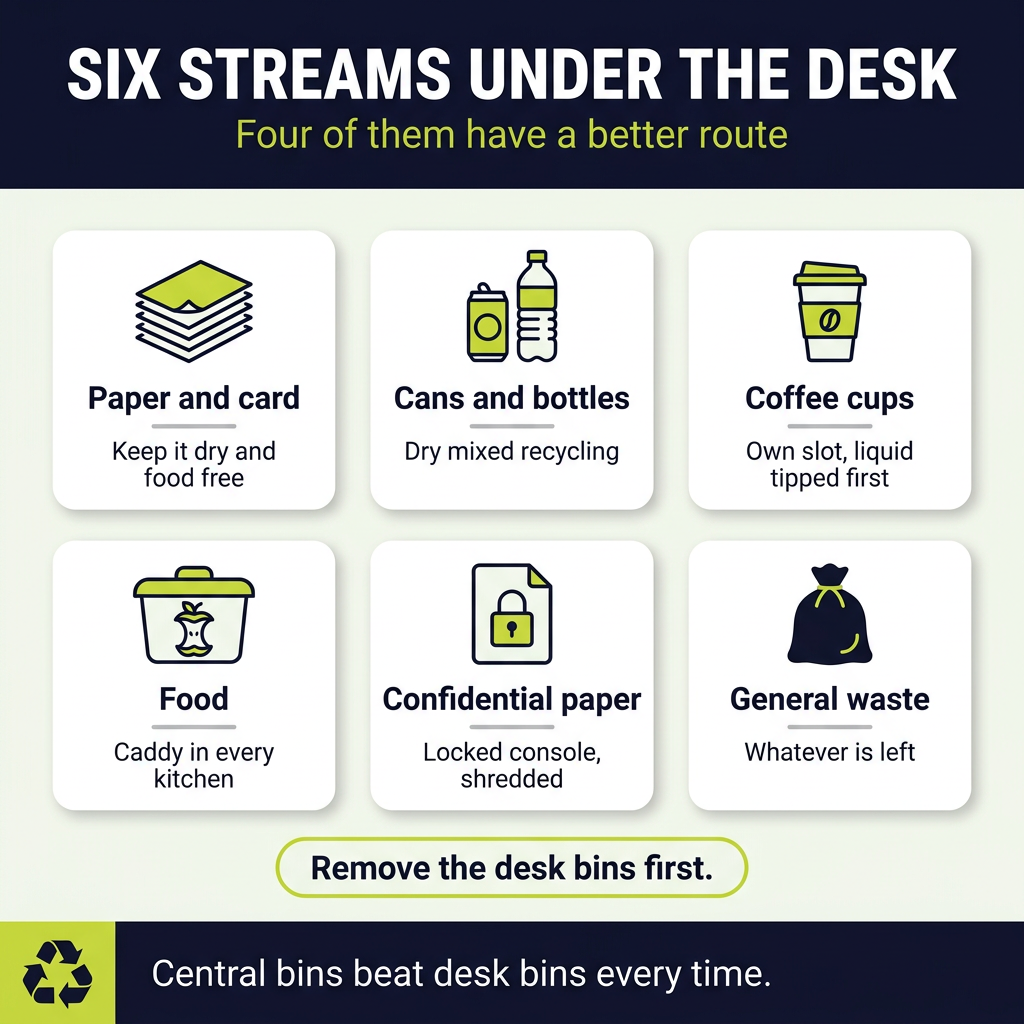
Paper and card: printouts, envelopes, delivery boxes and the packaging from the stationery order.
Drinks containers: cans, plastic bottles and glass from the fridge and the meeting rooms.
Coffee cups: takeaway cups from the street and the paper cups by the water cooler.
Food: lunch leftovers, fruit peel, coffee grounds and whatever the kitchen fridge gives up on Friday.
Confidential paper: anything with a name, a number or a contract on it.
General waste: crisp packets, film, tissues and the rest.
That is six streams, and four of them have a better route than the general bin. Our guide to separated collections for workplaces sets out what the law now expects.
Why the desk bin defeats every scheme
A desk bin is a personal general waste bin. Whatever recycling points you add, the bin under the desk is always closer.
People do not sort at the desk. They drop things in the nearest hole, and the nearest hole takes everything.
Remove the desk bins. It sounds drastic, and it is the single change that moves an office recycling rate most.
Replace them with a small number of central points, each with separate openings for each stream. Put them where people already walk: the kitchen, the print area and the exit route.
Staff complain for a week. After that, a walk to the kitchen becomes habit. The cleaners then empty a handful of points instead of every desk.
The coffee cup problem
Takeaway cups cause more confusion than anything else in an office.
Most have a thin plastic lining, so they do not belong in paper recycling. Most dry mixed recycling routes will not take them either.
Give cups their own slot or bin. Separate cup collections exist, and they keep cups out of the paper stream.
Tip the liquid first. A half-full cup ruins whatever bag it lands in. A small drain point or bucket by the cup bin solves it.
Encourage reusable cups. It costs little, and every reusable cup is one less item to sort.
Paper is the stream worth protecting
Office paper is clean, dry and high grade, which makes it one of the more valuable streams a building produces.
Keep it dry. Wet paper loses its value, and reprocessors may reject it. Never store paper sacks by the external doors.
Keep it free of food. A greasy sandwich wrapper turns a sack of good paper into contamination.
Separate confidential paper completely. Anything sensitive goes in a locked console, not an open recycling box.
A secure confidential waste service shreds it and returns a certificate. That protects the business and still sends the paper for recycling.
Delivery boxes need flattening before they go anywhere. Our paper and cardboard service covers card in volume.
Food waste is now part of the job
Many offices assumed food waste was a restaurant problem. Under Simpler Recycling, it is not.
Workplaces in England need separate food waste collections under the new rules. Our guide to the Simpler Recycling deadline explains the timeline for smaller firms.
Put a caddy in every kitchen. Small, lidded and emptied daily, so it never smells.
Coffee grounds count. Busy offices produce a surprising weight of them every week.
Food out of the general bin cuts weight. Food is heavy, so removing it lightens the residual stream.
Our food waste collections work for offices as well as kitchens. A modest caddy collection is often enough.
Meeting rooms, events and the Friday fridge
Some of the worst office waste never touches a desk.
Catered meetings create spikes. Platters, cups, bottles and leftover food arrive in one go, usually in a room with a single small bin.
Put a portable set of recycling bags in each meeting room on catering days. Ask the caterer to take back their own trays and packaging.
The kitchen fridge needs a weekly clear-out. Name a day, empty it into the food caddy, and wash the containers rather than binning them.
Office parties and client events follow the same pattern on a bigger scale. Book an extra recycling lift for the week after, rather than letting it overflow the general bin.
Seasonal peaks are predictable. The week after Christmas, year-end and office moves all produce far more card and paper than a normal week. Plan those extra collections before they arrive, not after the bins overflow.
Signs, colours and the cleaners
A scheme lives or dies on two groups of people. One is the staff who drop the waste, and the other is the cleaners who move it.
Use clear pictures, not policy. A photo of a can on the can slot beats a paragraph about materials.
Keep colours consistent across the building. The same colour for the same stream on every floor.
Brief the cleaning contractor. If they tip every bin into one sack at night, nothing the staff do matters.
Give the cleaners separate sacks for each stream and a clear place to leave them.
Check what leaves the building. Lift the lid on the external containers once a month. The contents tell you whether the scheme works.
Shared buildings and landlord services
Many offices sit in multi-tenant buildings where the landlord or managing agent runs the waste.
That causes a specific problem. You may be paying through the service charge for a scheme you cannot see or control.
Ask what the building actually provides. Separate streams, or one compactor for everything?
Ask for your share of the data. Tonnages and recycling rates matter if your company reports on them.
Remember duty of care still applies to you. Your waste is your responsibility, even when the landlord books the lorry.
If the building service falls short, you can often arrange a separate service for your own floors.
Measure it, then right-size it
Once the streams run separately, the containers and collections usually need adjusting.
Recycling volume goes up, and general waste goes down. Somebody sized the old contract for one big stream.
Half-empty bins on a fixed schedule cost money. Lifts you do not need are lifts you still pay for.
Match frequency to the real fill. Weekly might become fortnightly for general waste once food and recycling leave it.
Our guide to the invoice nobody reads covers the other places costs hide. Our dry mixed recycling service takes the cans, bottles and clean packaging in one container.
Frequently asked questions
What waste does an office need to separate?
In England, Simpler Recycling requires workplaces to separate dry recyclables, paper and card, and food waste from general waste. Smaller firms have a later deadline than larger ones.
Should we remove desk bins?
Usually, yes. Desk bins act as personal general waste bins, so central recycling points work far better without them.
Can coffee cups go in paper recycling?
Most cannot, because of the plastic lining. Give them a separate slot or collection, and tip the liquid out first.
Does an office really need a food waste collection?
Under the new rules in England, yes. A lidded caddy in each kitchen, emptied daily, usually covers it.
Who is responsible for waste in a shared building?
Your business keeps its duty of care, even if the landlord arranges collections. Ask the managing agent what the building provides and for your share of the data.
How do we handle confidential paper?
Keep it out of open recycling. Use locked consoles and a secure shredding service that issues a certificate of destruction.
The bottom line
Office waste is mostly clean and recyclable, and most of it still leaves in one bag.
Take out the desk bins, put central points where people walk, and give cups and food their own route.
Brief the cleaners, protect the paper, and check the external containers once a month.
Then right-size the collections, because the old contract suited a building that binned everything.
Priority Waste provides office recycling and waste collections across the UK. Confidential shredding and food waste sit on the same contract. Book a free waste review, and we will start with the bins under the desks.

