
The gates open at nine and the bins are already half full.
Build crews have been on site since dawn. Pallets, shrink wrap and coffee cups sit beside every stand.
By lunch the food court is busy and the bars are three deep. By teatime the bins by the main stage are overflowing.
Event waste does not build up over a month. It arrives in a few hours, and it all needs somewhere to go.
Why events break normal waste plans
A shop or office produces waste at a steady rate. A contract with a weekly lift suits that pattern.
An event works the other way. Nothing happens for weeks, then a week’s waste lands in an afternoon.
That changes the whole plan. You cannot wait for the bins to fill and then book a lorry.
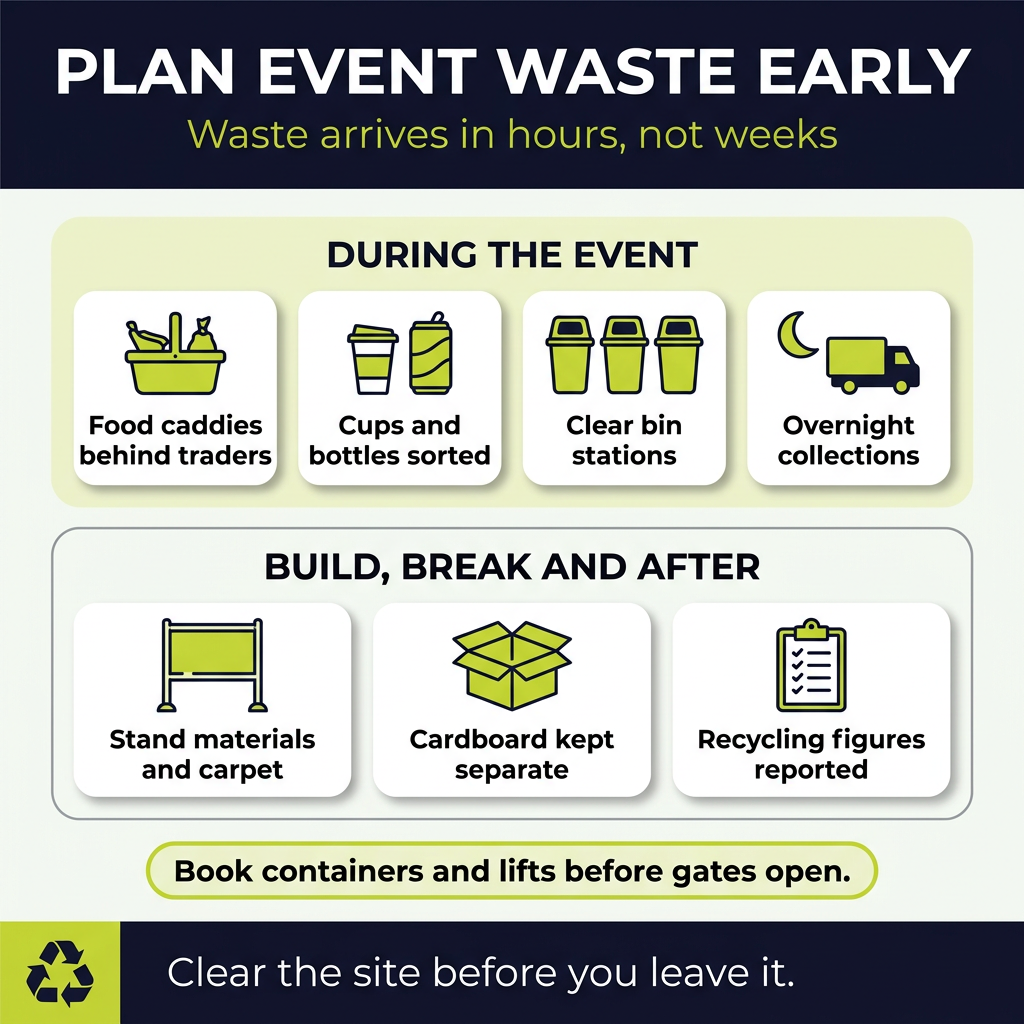
Plan containers and lifts before the gates open. Work out the streams, the volumes and the timings in advance.
Then book the collections to match the event programme, not the usual calendar of weekly lifts.
The same rule covers an exhibition hall, a weekend festival and a match day. It covers a one-day fun run as well.
Build and break days produce the most
Many organisers plan for the public days and forget the days either side.
Build day brings deliveries, and every stand arrives in boxes, crates and plastic film. The packaging comes off on the spot.
Break day is worse. Exhibitors pull down stands in a few hours and want to leave fast.
The waste from break is bulky and mixed. Expect stand panels, timber, carpet, display boards and a mountain of cardboard.
Give build and break their own containers. A large skip or roll on roll off container suits timber and stand materials.
Keep cardboard separate. Flat, dry card is easy to recycle, and our paper and cardboard service covers it in volume.
Carpet needs its own plan. Exhibition carpet often goes down for a few days and comes up in long rolls. Ask what route it takes before break day starts.
Food traders and food waste
Food stalls generate heavy waste, and they generate it fast during service.
Expect leftovers, peelings, spoiled stock and used oil. Most of it comes out during service, when traders have no time to walk far.
Put food caddies behind every trader row. Lidded, close by and emptied through the day.
Keep food out of the general bins, because it adds weight, smells and draws wasps and gulls.
Write the waste rules into every trader agreement and exhibitor manual. Say where food waste goes, where packaging goes and where oil goes.
Our food waste collections suit event traders as well as fixed kitchens. Used cooking oil needs a separate, sealed container.
Cups and bottles at the bars
Bars produce the most items per head of any part of a site.
Plastic cups, cans, bottles and glass pile up wherever people drink. Most of them end up on the ground if the bins are too far away.
Decide on cups before the event. A reusable cup scheme cuts the volume. Single use cups need a clear recycling route.
Glass is heavy and dangerous on a busy site, so keep it behind the bar where you can. Our glass recycling service takes bottles in bulk.
Cans and plastic bottles go into one stream. Our dry mixed recycling takes them in a single container, as long as food stays out.
Bin stations people can read in a second
Visitors at an event are moving, eating and talking, and nobody stops to read a sign.
Group bins into clear stations. Put general waste, recycling and food side by side, never one bin on its own.
Use big pictures on each bin, since a picture of a cup and a can beats any list of materials.
Keep colours the same across the whole site. Visitors learn the system at the first station and use it at the next.
Volunteers make a real difference at busy stations during peak periods. One person at peak times stops the wrong items going in.
Empty stations before they overflow, because a full bin turns into a pile beside it within minutes.
Back of house and access for lorries
Every bin on site needs somewhere to empty into, and that place is the back of house compound.
Site the compound early, with hard standing, space for the containers and a clear route for a lorry.
Plan vehicle access around the crowds. A collection lorry cannot drive through a busy arena or a packed festival field.
Agree the access times with the site manager. Some venues only allow vehicles in before opening or after closing time.
Keep the compound fenced, supervised and properly organised. Loose waste blows around, and unsupervised containers fill with things that should not be there.
Overnight collections keep day two clean
Multi-day events need the compound emptied between days, ready for the next morning.
Book lifts for the hours when the site has closed. Overnight and early morning slots avoid the crowds and keep the access routes clear.
Swap full containers for empty ones rather than waiting for them to tip. That keeps the compound ready for the morning.
Check the forecast as well as the ticket numbers. Hot weather means more drinks and more cups, so book more lifts.
We run collections across the UK with our own transport and a managed contractor network. Next-day collections are available subject to location.
Site clearance after the crowds leave
When the last visitor goes, the site still looks like an event.
Litter across the field, abandoned tents, broken gazebos and the contents of the compound all need clearing.
Plan the clearance as its own job. It needs labour, vehicles and containers, booked before the event, not after.
Our site clearance service handles this type of work. Our guide to commercial site clearance explains how to scope and run a clearance.
Some sites need a mix of services. Our guide on choosing between a skip, wheelie bin or clearance crew helps match the job to the service.
Hazardous or electrical waste found during clearance needs a specialist route. Keep it apart and flag it before collection.
Exhibitors who leave stands behind
Every venue has the same complaint. Some exhibitors pack their stock and walk away from the stand.
That leaves the organiser holding the panels, the flooring and the disposal bill.
Put stand removal in the exhibitor contract. Say clearly who removes what, and by when.
Charge for anything left on the floor after break closes, and behaviour changes fast.
Offer a paid removal option for exhibitors who would rather not take it home. That keeps the waste in a known route.
Remember duty of care. Your waste stays your responsibility until it reaches a licensed carrier. Our guide to duty of care rules covers the paperwork.
Recycling figures for the organiser’s report
Sponsors, venues and local councils often ask what happened to the waste afterwards.
Ask for tonnages by stream after the event. General waste, recycling, food, glass and card each need their own figure.
Waste transfer notes back those figures up, so keep them with the event file.
Separate streams produce far more useful environmental reports. A single mixed skip gives you one number and very little to say.
Workplaces in England now sit under Simpler Recycling, and some event sites will fall within it. Check with the relevant authority for your venue.
Frequently asked questions
When should we book event waste collections?
Book them as soon as you have fixed the event dates and site plan. Popular weekends fill quickly, and late bookings limit your options.
What waste does an exhibition produce?
Packaging, cardboard, stand materials, timber and carpet. Build and break days produce far more than the public days.
How many bin stations does an event need?
It depends on the crowd, the layout and the food offer. Put stations near food, bars, entrances and toilets as a starting point.
Can collections happen during the event?
Yes, but lorries need safe access away from the public. Overnight or early morning lifts usually work best.
Who clears up after the event?
The organiser stays responsible for the waste. Book a clearance crew before the event so the site gets cleared on time.
Can we get recycling figures for our report?
Yes. Ask for tonnages by stream and keep the waste transfer notes as evidence.
The bottom line
Event waste arrives in hours, so plan the containers and lifts before the gates open.
Give build and break days their own containers, and keep food, cups and card in separate streams.
Run clear bin stations, a staffed compound and overnight lifts. Then book the clearance before the crowds arrive.
Priority Waste provides event waste collections and site clearance across the UK. Book a free waste review, and we will start with your site plan.

