
A business with twelve locations usually has somewhere between four and nine waste suppliers. Nobody chose that. It accumulated.
A site manager arranged something locally in 2019. Another location inherited a contract with the building. Two more were set up by a facilities manager who has since left, and one has been rolling on auto-renewal for so long that nobody remembers who signed it.
The result is a spend nobody can see, a compliance position nobody can evidence, and a price per lift that varies by more than you would believe between sites doing the same thing.
The real cost of a fragmented estate
The obvious problem is price. That is not the expensive one.
You cannot benchmark. Nine suppliers means nine contract structures. When the Leeds site pays more than the Bristol site, you have no way to tell a genuine cost difference from a worse deal.
Auto-renewals go unchallenged. Waste contracts commonly renew automatically with a short notice window. Across a dozen sites, at least one is always inside a window nobody is watching. That is where the largest single increases hide.
Compliance evidence is scattered. When a client audit or an ISO 14001 surveillance visit asks for waste transfer notes across the estate, somebody spends two weeks emailing site managers. Some of those notes will not exist.
Sustainability reporting is guesswork. If you report recycling rates, carbon or diversion from landfill, you need consistent data. Nine suppliers produce nine formats, several of which report nothing useful at all.
Nobody owns service failure. A missed collection in Newcastle is a local problem solved locally, which usually means an expensive ad hoc lift that never gets reviewed centrally.
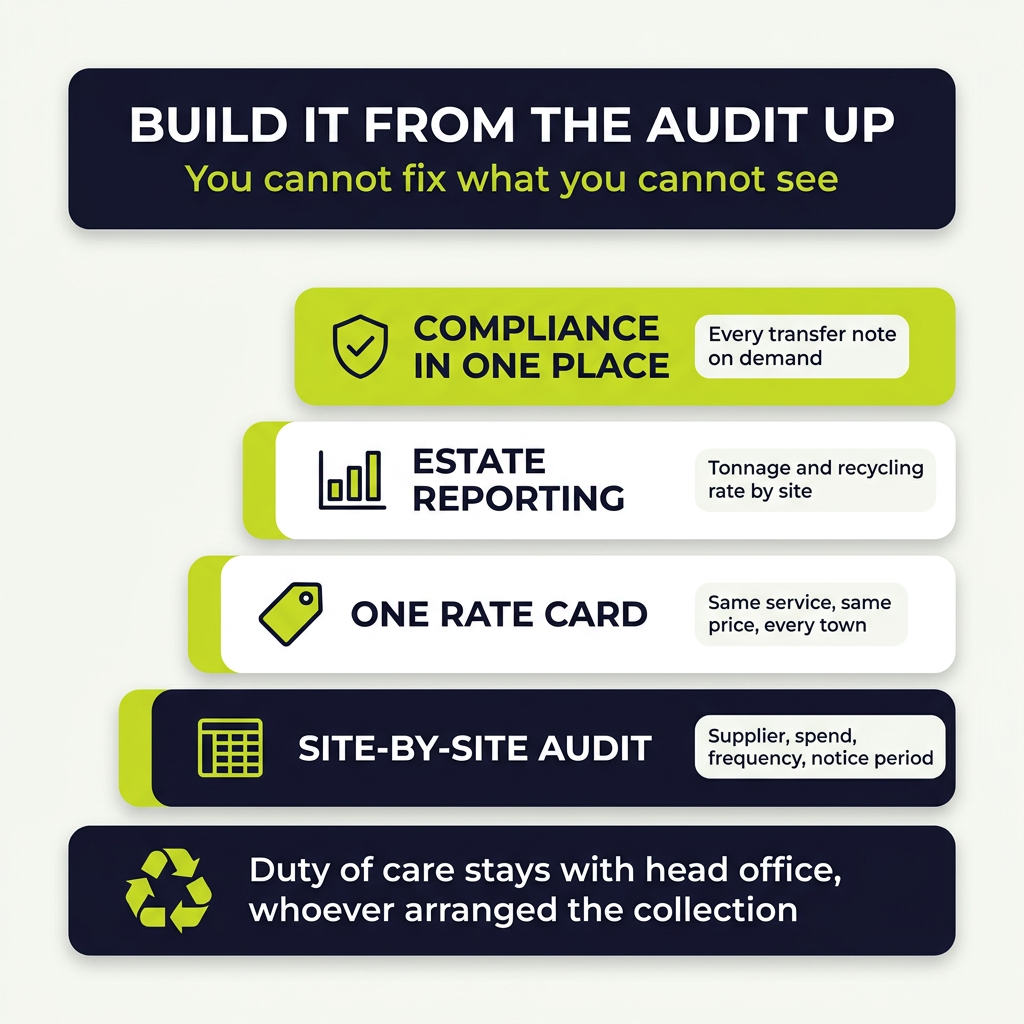
Duty of care sits with head office anyway. The legal responsibility for waste produced across the estate belongs to the business, not to whoever happened to arrange the collection. Fragmentation does not distribute that risk. It just hides it.
What consolidation actually gets you
Done well, a single national contract delivers five things.
One rate card, applied consistently. Same service, same price, whichever town it is in. This alone typically closes the gap between your best and worst performing sites.
One invoice, with site-level detail. Consolidated for accounts payable, broken down for cost centre reporting. Insist on both. An invoice that is consolidated but not itemised removes your ability to see anything.
One escalation route. A named account manager and a single number, rather than twelve local relationships of varying quality.
Estate-wide reporting. Tonnage, stream mix, recycling rate and diversion, by site and consolidated, in one consistent format. This is the piece that makes ISO 14001, client audits and sustainability reporting straightforward instead of painful.
Compliance in one place. Waste transfer notes and consignment notes retrievable centrally, on demand, rather than requested from site managers under pressure.
When consolidation is the wrong answer
It is not always right, and any provider who says it always is should be treated carefully.
When a local operator is genuinely cheaper and genuinely good. Some regional operators have a depot two miles from your site and cost structures a national player cannot match. Consolidating that site can cost you money.
When your sites are radically different. A head office, a manufacturing plant and twenty retail units do not have a common waste profile. Sometimes the right structure is two or three contracts by site type, not one contract for everything.
When the specialist streams are the majority of the spend. If most of your cost is hazardous or clinical waste, specialist capability matters far more than consolidation. Choose on that first.
When you are locked into long notice periods. Consolidation only works if you can actually exit the existing arrangements. Map the notice periods before you plan the transition, not after.
Most multi-site businesses end up with a hybrid. One national contract covers the bulk of the standard streams. Two or three local or specialist arrangements are retained where they genuinely outperform.
The audit that has to come first
Do not go to market before you know what you have. This is the work, and it takes a couple of weeks.
Build one spreadsheet with a row per site and these columns:
- Site name, address and postcode
- Current supplier
- Contract end date and notice period
- Services and container sizes
- Scheduled collection frequency
- Actual collections in the last twelve months, including unscheduled lifts
- Annual spend
- Recycling rate, if reported
- Any local access constraints
- Whether waste transfer documentation is on file
That last column is usually the most revealing. It is also the one that determines how a compliance audit will go.
Two patterns fall straight out of this exercise every time. First, several sites are paying for scheduled collections on containers that are half empty. Second, at least one site is ordering unscheduled lifts most months, which means their schedule has been wrong for years. Both are fixed by right-sizing, not by changing supplier. Our guide to reading a waste invoice properly covers the specific line items to check on each one.
Questions to ask any national provider
Every waste company claims national coverage. No single company owns depots everywhere in the UK, so every national service involves subcontracting somewhere. That is normal. The question is whether they will tell you where.
Ask:
- Which of our sites would you service with your own fleet, and which would be subcontracted? Ask for it site by site.
- What reporting do we get, in what format, and how often? Ask to see a sample report from a real customer before signing.
- What is the escalation process and the response time for a missed collection?
- How are price changes notified, and how much notice do we get?
- Can we see all waste transfer documentation centrally, on demand?
- What happens at renewal? Get the notice period and the renewal mechanism in writing.
- How do you handle sites we open or close during the term?
Question one is the one that separates providers. A confident operator answers it plainly.
Frequently asked questions
Is a single national waste contract always cheaper?
No. Consolidation usually reduces cost by removing price variation between sites and improving container right-sizing, but a strong regional operator with a nearby depot can sometimes beat a national rate at an individual site. The reliable savings come from right-sizing collections and eliminating unscheduled lifts, which you can achieve under either structure.
How do I find out what my business actually spends on waste across all sites?
Pull twelve months of invoices for every site and build a single spreadsheet with supplier, services, frequency, actual collections and annual spend per location. Most multi-site businesses find the total is materially higher than the figure carried in the budget, because ad hoc lifts and site-level arrangements never make it into the central number.
What waste reporting should a multi-site business expect?
At minimum: tonnage by stream by site, recycling rate and diversion from landfill, consolidated and site-level views, and access to waste transfer and consignment notes on demand. If you hold ISO 14001 or report on sustainability, ask to see a sample report before signing, because report quality varies enormously between providers.
How long does it take to move a multi-site estate to one supplier?
Typically three to six months, and the constraint is almost always notice periods on existing contracts rather than mobilisation. Map every contract end date and notice window first. Most estates transition in waves as contracts expire rather than all at once.
Who is legally responsible for waste at each of our sites?
The business that produced the waste, which means your company, regardless of who arranged the collection locally. Duty of care under the Environmental Protection Act 1990 cannot be delegated to a site manager or transferred to a supplier. Centralising the contract does not create that responsibility; it simply makes it possible to evidence.
The bottom line
A fragmented waste estate is rarely a purchasing failure. It is an accumulation of reasonable local decisions that nobody has ever looked at together.
Build the spreadsheet first. In most cases it tells you the answer before you have spoken to a single supplier, and it turns a vague sense that you are overpaying into a number you can act on.
Priority Waste manages multi-site and national waste contracts for businesses across the UK, with consolidated invoicing, site-level reporting and centrally held compliance documentation. Book a free waste review, and we will build the estate audit with you.

