
Ask a business owner whether they produce clinical waste, and most will say no. Ask whether anyone on the premises has ever used a needle, dealt with a nosebleed, changed a nappy or emptied a sanitary bin, and the answer changes.
Clinical and offensive waste is not a hospital category. It is a description of the material, and it applies wherever that material is produced. A tattoo studio in a high street produces it. So does a care home, a nursery, a gym or a beauty salon. So does a piercing studio, a vet, a dental practice, a pharmacy, and any workplace with a proper first aid room.
The rules do not scale down for small businesses. They apply in full.
The three categories, and why the distinction saves money
Getting the category right is the difference between a manageable cost and a very large one. Treating everything as infectious waste is safe, but it is also the most expensive possible approach, often by a wide margin.
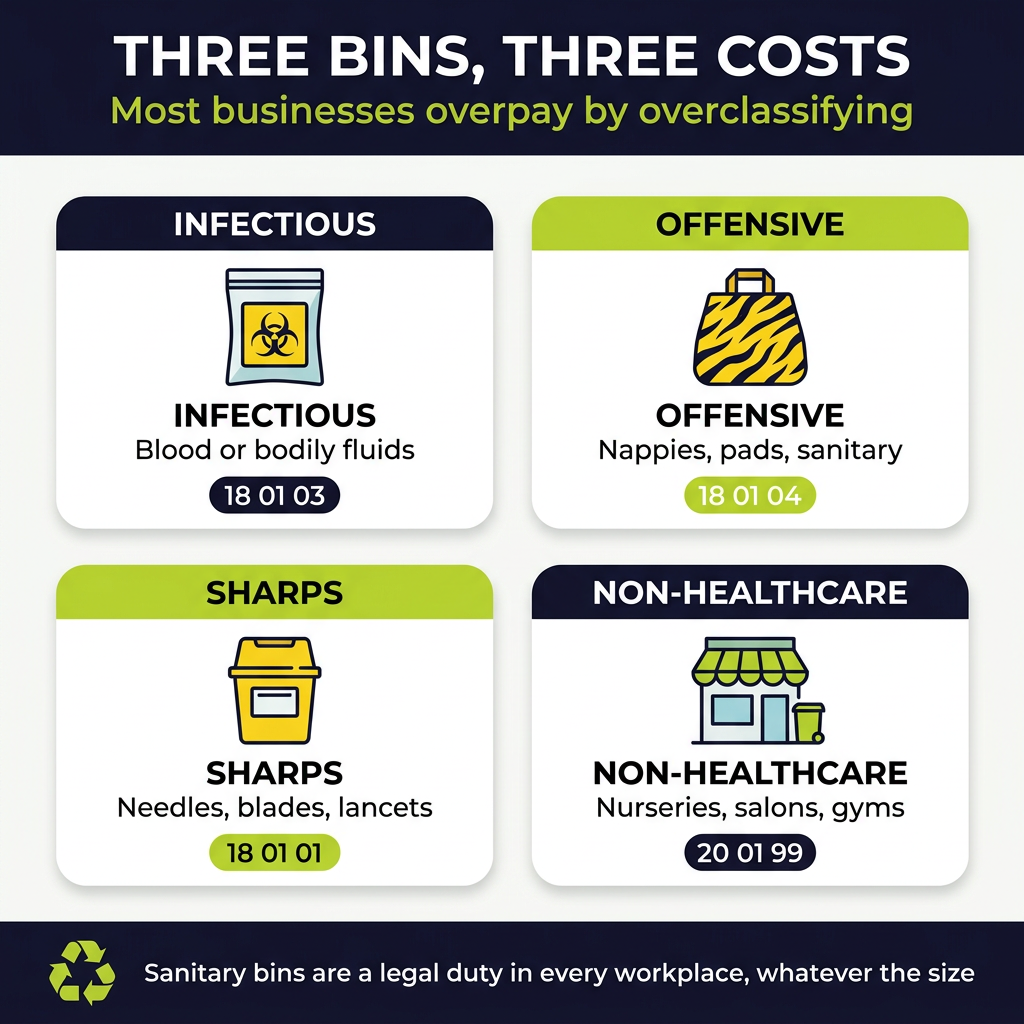
Infectious clinical waste is material contaminated with blood or other bodily fluids, or that poses a genuine risk of infection. It requires specialist treatment, typically incineration or alternative treatment, and it carries the highest disposal cost.
Offensive waste, sometimes called hygiene waste, is non-infectious and contains no pharmaceutical or chemical substances, but is unpleasant and needs handling with care. Nappies, incontinence pads, sanitary waste and non-infectious PPE fall here. It is a lower-cost stream because it does not need the same treatment.
Sharps are anything that can puncture skin. Needles, blades, scalpels, lancets, cannulas and broken glass ampoules. Sharps always require a rigid, sealed, UN-approved container, regardless of whether they are contaminated.
The commercial point is this: a great deal of what businesses send as infectious waste is actually offensive waste. Getting the classification right, with evidence, is a legitimate and often substantial saving.
The codes your paperwork needs
Every waste stream leaving your site needs a European Waste Catalogue code on the transfer or consignment note. For clinical and related waste, the ones you are most likely to encounter are:
- 18 01 03 Infectious waste from healthcare activities. Hazardous.
- 18 01 04 Non-infectious healthcare waste such as dressings, plaster casts and PPE. This is the standard offensive waste code in a healthcare setting.
- 18 01 01 Sharps not contaminated with medicines.
- 18 01 09 Medicines other than cytotoxic and cytostatic.
- 20 01 99 Other municipal waste not otherwise specified. Commonly used for offensive waste from non-healthcare settings, such as nappies from a nursery or a care home.
Codes ending in an asterisk in the full catalogue are hazardous, and hazardous waste carries additional consignment note requirements and record-keeping obligations.
You do not need to memorise the catalogue. You do need your provider to assign codes correctly, and you need to keep the paperwork. Our duty of care guide covers retention periods and what an inspector actually asks to see.
The businesses that get caught out
These are the sectors where clinical or offensive waste appears without anybody planning for it.
Tattoo and piercing studios. Needles and blades are sharps, and under the Hazardous Waste Regulations 2005 they must go into approved sharps containers with the correct code. Gloves, wipes, cotton pads and paper towels that have contacted blood or ink are treated as clinical waste. Everything else in the studio, including clean packaging, is not. That split is worth getting right, because studios frequently pay clinical rates for the lot.
Care and residential homes. Incontinence pads and nappies in volume. This is almost always offensive waste rather than infectious, and it is one of the most common overclassifications in the sector.
Nurseries and childcare. Nappy waste in quantity, plus first aid material.
Gyms, spas and beauty salons. Sanitary waste, used razors and blades, microneedling and dermaplaning consumables, and first aid.
Veterinary practices. Sharps, pharmaceuticals, and animal tissue, which has its own separate rules under animal by-product legislation.
Pharmacies. Returned and date-expired medicines, denatured controlled drugs, and sharps from vaccination services.
Any workplace with a real first aid room. Manufacturing sites, warehouses, construction compounds and schools all generate blood-contaminated dressings. In small volumes, but they still need a compliant route off-site.
Sanitary waste is not optional
The Workplace (Health, Safety and Welfare) Regulations 1992 require suitable means of disposal for sanitary dressings in any workplace with female employees. That is a legal duty, not a courtesy.
In practice, it means a lidded, hands-free sanitary bin in every relevant washroom, serviced on a defined schedule by a licensed contractor. Emptying one into the general waste bin is not compliance, however small the business.
This is the single most commonly missed requirement among small commercial premises, and it is also the easiest one to fix.
Containers, colours and the bits that trip people up
Clinical waste in the UK runs on a colour-coded system. Providers vary slightly, but the widely used standard is:
- Yellow for infectious waste requiring incineration
- Orange for infectious waste that can go for alternative treatment
- Tiger stripe, yellow and black, for offensive and hygiene waste
- Purple for cytotoxic and cytostatic waste
- Blue for medicinal waste
- Yellow lid sharps bins for sharps contaminated with medicines, orange lid for sharps not contaminated with medicines
Three practical rules matter more than memorising the colours.
Never overfill a sharps container. They have a fill line, usually around three-quarters. Past that, closing it safely becomes a genuine injury risk.
Never decant clinical waste between containers. Once it is in, it stays in, and the container is sealed and labelled.
Label with your business name and address. Clinical waste containers must be traceable back to the producer. Unlabelled containers get refused at the point of collection.
Frequently asked questions
Does my business need a clinical waste contract if we only produce a small amount?
Yes, if you produce clinical or offensive waste at all. There is no minimum threshold that exempts a business. What changes with volume is the practical arrangement. A small producer might have a scheduled collection every few months rather than weekly, but the material still needs a licensed carrier, correct containers and waste transfer documentation.
What is the difference between clinical waste and offensive waste?
Clinical waste poses a risk of infection or contains pharmaceutical or chemical substances. Offensive waste is non-infectious and contains neither, but is unpleasant to handle. Nappies, incontinence pads and sanitary waste are usually offensive waste. The distinction matters commercially, because offensive waste does not require the same treatment and costs less to dispose of.
How should a tattoo studio dispose of needles?
Needles and blades are sharps and must go into a rigid, UN-approved sharps container, sealed and labelled with the studio’s details, then collected by a licensed carrier under the correct EWC code. Under the Hazardous Waste Regulations 2005, they cannot go into general waste or any soft-sided bag. Contaminated gloves, wipes and paper are handled as clinical waste separately.
Do I legally have to provide sanitary bins?
Yes. The Workplace (Health, Safety and Welfare) Regulations 1992 require suitable means for the disposal of sanitary dressings in workplaces with female employees. That means a serviced sanitary disposal unit in the relevant washrooms, emptied by a licensed provider. It applies regardless of company size.
How long do I need to keep clinical waste paperwork?
Waste transfer notes must be kept for at least two years. Hazardous waste consignment notes must be kept for at least three years. Keep them somewhere you can retrieve them quickly, because the request usually arrives at short notice, either from a regulator or from a client running a supply chain audit.
The bottom line
Clinical waste is not defined by the sign above your door. It is defined by what is in the bin.
Does anyone on your premises use a needle or blade, handle bodily fluids, change a nappy or empty a sanitary bin? Then you are a producer, and the same rules apply to you as to a hospital. The good news is that most small producers are overpaying, not underpaying, because the offensive waste category is so widely misapplied.
Get the classification right, and the compliance and the cost usually improve together.
Priority Waste provides clinical, offensive and sharps collections for businesses nationally, with correct EWC coding and full documentation, backed by ISO 9001 and ISO 14001 certification. Book a free waste review, and we will check whether your current classification is costing you more than it should.

