
Most businesses believe their plastic gets recycled. Some of it does.
The rest is doing something else, and the reason is almost never the material. It is how the material arrived.
Plastic is not one waste stream. It is about six of them wearing the same name.
The split that decides everything
Before anything else, sort your plastic into two piles in your head.
Rigid plastics hold their shape. Bottles, tubs, trays, crates, drums and moulded packaging.
Films and flexibles crumple. Shrink wrap, pallet wrap, bags, sacks and sheeting.
These go to different places. Businesses that separate everything else well still bin their film.
Film is also the easier win. Warehouses produce it in clean, uniform quantities, which is exactly what reprocessors want.
If you use pallets, you produce recyclable film. Our plastic recycling service handles both halves.
Clean and sorted beats large and mixed
Value in plastic comes from consistency. A reprocessor wants one polymer, one colour range, and no food on it.
A bale of clear pallet wrap has real value. It is a single material, from one source, in volume.
The same weight of mixed plastic has very little. Sorting costs money and mixed loads often fail.
Contamination is the usual killer. Food residue, liquid, tape, labels and general rubbish downgrade a load fast.
Colour matters more than people expect. Clear film outvalues coloured film, and both outvalue a mix.
This is the same principle that governs dry mixed recycling. Cleaner in, cheaper out.
What businesses get wrong with film
Film is where the biggest gains sit, and where the habits are worst.
It ends up in general waste because it is light. Nobody notices a bin of wrap the way they notice a bin of bottles.
It gets mixed with sacks that held something else. A wrap bale with dirty rubble sacks in it is a rejected bale.
It gets left loose and blows around the yard. Then it becomes a litter complaint as well as a waste cost.
Nobody gives it a container. So it goes wherever the nearest bin is.
Give film its own marked container where staff strip the pallets. That single change fixes most of it.
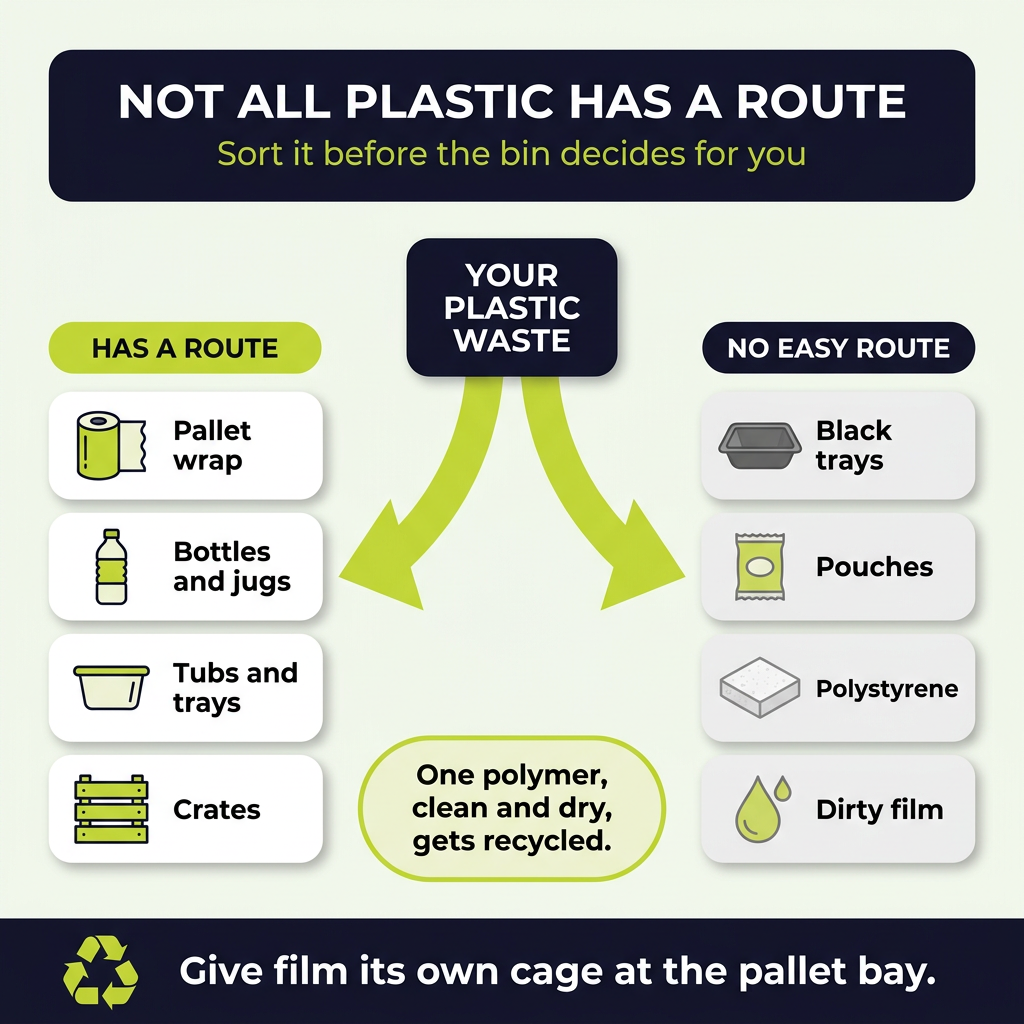
The rigid plastics that do have a route
Not everything rigid is recyclable, but more is than most sites assume.
Bottles and jugs. HDPE and PET, the two best understood polymers in the system.
Tubs, trays and pots. Usually polypropylene, and usually fine if they are empty and dry.
Crates, trays and returnable transit packaging. Often high grade and worth separating on their own.
Drums and IBCs. These depend on what they held. An empty chemical drum is not general plastic.
Damaged pallets and boxes. Plastic pallets have a genuine recycling route, unlike a lot of moulded packaging.
Bulky moulded packaging. Protective inserts and formed trays vary a great deal, so ask before assuming either way.
Tell us what you actually produce. The answer often includes a stream you are paying to bury.
The plastics with no easy route
Being honest about this matters more than being encouraging.
Black plastic trays. Optical sorters at many facilities cannot see carbon black, so the tray passes through unsorted.
Multi-layer and composite packaging. Crisp packets, pouches and laminated film fuse materials that no process can pull apart.
Polystyrene and expanded foam. Mostly air, expensive to move, and accepted in very few places.
Anything that held a hazardous substance. That is a hazardous waste question, not a recycling one.
Heavily contaminated film. Wrap soaked in oil or food is disposal, whatever it started as.
Knowing which of your packaging has no route is useful information for the people who buy it.
It also stops staff from losing faith in the bins. A worker who sees the wrong thing collected stops trusting any of the labels.
Packaging tax turned this into a finance question
The Plastic Packaging Tax applies to plastic packaging with insufficient recycled content, above a set annual threshold.
It made recycled content a line item. Packaging buyers now have a direct cost reason to care.
Your waste data supports that conversation. What you throw away tells you what you are buying.
Reporting obligations sit with producers and importers. Check whether your business crosses the threshold, because many do without realising.
If you both buy and discard a lot of packaging, those two conversations should be in the same room.
Setting the bins up so staff use them
Plastic separation fails at the bin, not at the policy.
Put the container where the waste is made. Film goes by the pallet bay, not by the office door.
Label with pictures, not polymer codes. Nobody on a warehouse floor is reading a resin identification number.
Make the right bin the nearest bin. If general waste is closer, general waste wins every time.
Tell agency and night staff. Most contamination arrives on a shift that never got the briefing.
Our guide to separated collections for workplaces covers the wider set-up.
When a baler pays for itself
Loose film is mostly air, and air is what you pay to transport.
Baled film takes far less space. That means fewer collections for the same tonnage.
Bales are worth more than loose material. Some volumes earn a rebate rather than a charge.
It needs the space and the discipline. A baler nobody empties becomes an obstacle in a gangway.
Volume decides it. Below a certain throughput, the maths does not work, and we will say so.
Check the insurance position first. Baled material stored indoors changes your fire loading, and your insurer will have a view.
The same logic applies to cardboard, which we covered in our guide to balers and volume.
Frequently asked questions
Is all plastic recyclable?
No. Bottles, tubs, trays, crates and clean film have established routes. Black plastic, multi-layer pouches, polystyrene and contaminated packaging mostly do not.
Knowing which of your packaging has no route is worth telling whoever buys it.
Can shrink wrap and pallet wrap be recycled?
Yes, and it is one of the better commercial streams. Clean clear film from a warehouse is uniform and in demand.
Keep it separate from dirty sacks and other packaging, and give it a container at the pallet bay.
Does plastic need washing before collection?
It needs to be empty and dry rather than washed. Food residue and liquid are what downgrade a load.
A quick scrape and drain is enough for most tubs and trays.
Why is black plastic a problem?
Many sorting facilities identify plastics with near-infrared scanners, and carbon black pigment does not reflect that light.
The tray is not detected, so it is not sorted, regardless of the polymer underneath.
What is the Plastic Packaging Tax?
A tax on plastic packaging that does not meet a minimum recycled content, charged above an annual weight threshold.
It applies to producers and importers, so check whether your business crosses it rather than assuming it does not.
Should we buy a baler for plastic film?
Only above a certain volume. Baling cuts collections and raises the value of the material, but it needs floor space and a routine.
Tell us your weekly film volume, and we will tell you honestly whether it stacks up.
Can plastic drums be recycled?
It depends on what was in them. Drums that held food-grade or inert material often have a route.
Anything that held a chemical is a hazardous waste question and needs handling as one.
The bottom line
Plastic recycling fails on presentation far more often than on chemistry. One polymer, clean and dry, in its own container, gets recycled.
Film is the stream most businesses miss, and it is usually the easiest one to fix.
Put the bin where staff strip the pallets, label it with a picture, and brief the night shift.
Then ask what your rejected packaging is costing you at the buying end as well as the binning end.
Priority Waste provides commercial plastic recycling across the UK, covering rigid plastics, film and baled material. We work with warehouses, manufacturers and retailers.
Book a free waste review. We will tell you which of your plastics have a route, and which do not.

