
Lease end dates do not move. Completion dates do not move. The clearance almost always does.
The pattern is remarkably consistent. A business books a clearance for the last week. On day one, they discover the plant room contains something nobody expected. The final three days then go on premium rates, fixing a problem a site survey would have found six weeks earlier.
Site clearance is not a skip and a strong team. It is a sequencing problem with a legal deadline attached, and the money is made or lost in the planning.
Start with the lease, not the skip
Before anyone books anything, read the dilapidations clause. It defines what “clear” legally means for your site, and it varies enormously.
Some leases require the premises returned to shell. Some require original fixtures reinstated. Some require the removal of alterations you made, and some require you to leave them.
Get three things pinned down in writing.
The schedule of condition, if one exists from the start of the lease. This is your evidence of what was there when you arrived.
What counts as a tenant’s fixture and must therefore come out, versus a landlord’s fixture that must stay. Partitions, air conditioning, cabling, flooring and mezzanines are the usual points of dispute.
The handover standard, in plain language. “Vacant possession” and “clear and swept” and “reinstated to original specification” are three very different jobs at three very different prices.
A dilapidations dispute costs far more than any clearance. An hour with the lease at the start is the highest-return hour in the whole project.
Survey the site before you price it
Every clearance quote should follow a physical survey. A quote given over the phone from a floor area is a guess, and guesses get revised upwards mid-job when it is too late to shop around.
A proper survey covers:
- Volume and material mix, room by room
- Access, including lorry size, turning circles, loading bay height, lift capacity and whether the road needs a permit
- Hazardous materials, which is where the surprises live
- Recoverable value, particularly metal, IT equipment and resalable furniture
- Confidential material in filing rooms, servers and archived storage
- Working hours restrictions, especially in shared buildings or town centre locations
- Live services, meaning what still needs to be isolated by a qualified person before anything comes out
That last one is the most common cause of a stalled clearance. Nothing comes out of a plant room until power, gas and water are properly isolated and certified, and booking that in is not a same-day job.
Where the hazardous waste hides
This is the part that derails timelines, because hazardous waste needs consignment notes, licensed carriers and sometimes specialist contractors who are booked weeks in advance.
In any commercial building built or refurbished before 2000, asbestos must be assumed until surveyed. It appears in ceiling tiles, floor tiles and the bitumen beneath them, pipe lagging, cement roof sheets, soffits, fire doors and Artex. A refurbishment and demolition asbestos survey is a legal requirement before intrusive work, and it is the single most common thing missing from a clearance plan.
Beyond asbestos, the reliable finds are:
- Fluorescent tubes and lamps, which contain mercury and are hazardous
- Fridges, freezers and air conditioning units, which contain regulated refrigerant gases and must be degassed by a qualified engineer before disposal
- Oils, coolants and hydraulic fluid in workshop equipment and lift mechanisms
- Paint, solvents, adhesives and sealants in maintenance stores
- Batteries, including UPS units in server rooms and emergency lighting cells
- Chemicals in cleaning cupboards, labs and print rooms
- Fire extinguishers, which are pressurised and need a specialist route
- Smoke detectors, some older types of which are ionising and radioactive
None of these is difficult. All of them are slow if discovered on the last Thursday.
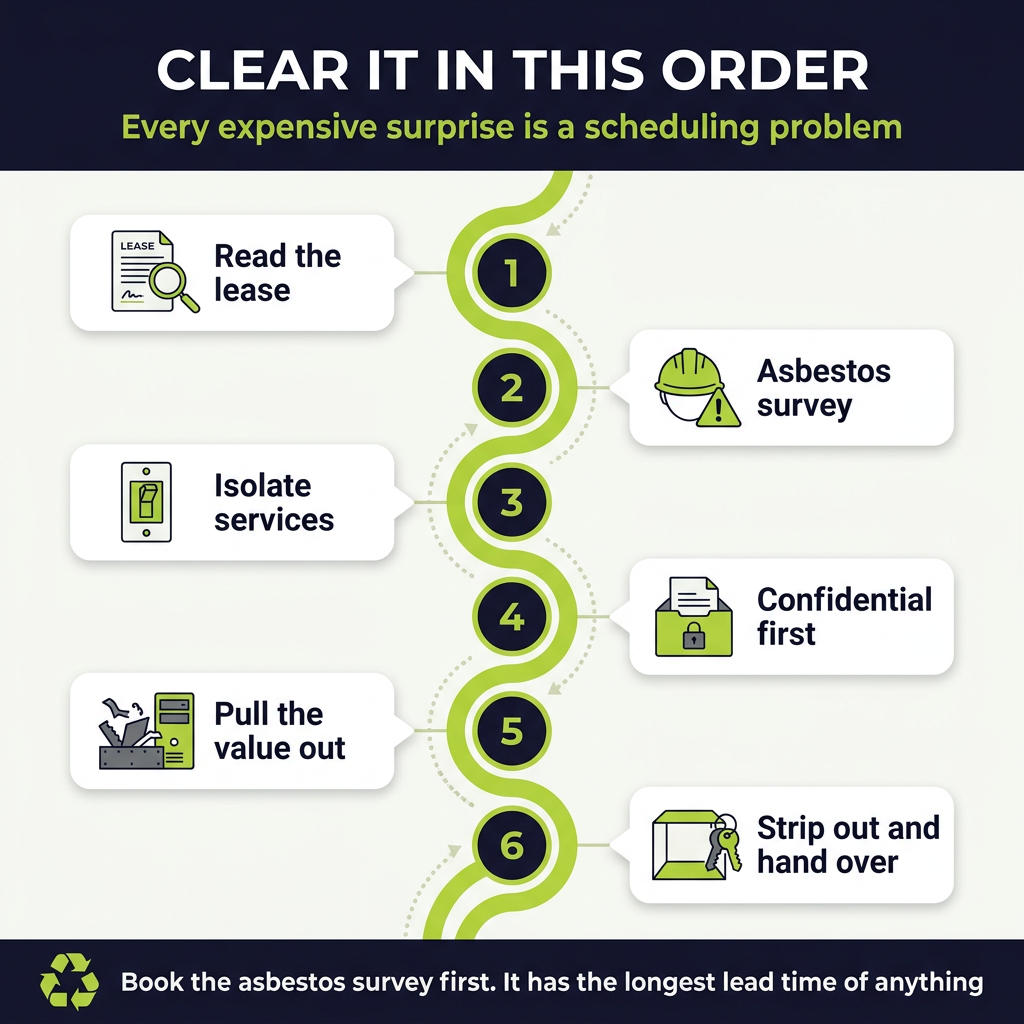
The sequence that actually works
Clearances run late when they are done in the wrong order. This sequence works.
- Read the lease and confirm the handover standard. Week one.
- Commission the asbestos survey if the building predates 2000. This has the longest lead time of anything on the list.
- Physical site survey and quote. Room by room, with a written material breakdown.
- Isolate and certify live services. Booked well ahead, not on the day.
- Remove confidential and data-bearing material first. Files, servers, drives, HR records. This is a separate secure stream with a certificate of destruction, and it must not be swept up with general clearance. See what businesses bin without thinking.
- Segregate and remove recoverable value. Metal, IT equipment and saleable furniture come out before anything gets mixed. Once it is in a general skip, its value is gone.
- Remove hazardous waste under consignment by licensed specialists.
- Strip out and general clearance. The bulk of the work, and the easy part by now.
- Reinstatement, if the lease requires it.
- Final clean, photographic record and paperwork pack.
Point six is where the money is. Metal, IT equipment and furniture all have recovery value that can offset a meaningful share of the clearance cost, but only if they are pulled before they are mixed. Our guide to metal recycling rebates explains how that value is calculated.
The paperwork pack you should walk away with
At the end, ask for all of it in one folder. You will need it, sometimes years later.
- Waste transfer notes for every non-hazardous load
- Hazardous waste consignment notes for every hazardous load
- Certificate of destruction for confidential and data-bearing material
- WEEE disposal records for electrical equipment
- Refrigerant handling certificates for any cooling equipment
- Weighbridge tickets and a final waste breakdown by stream
- Photographic record of the handover condition
- Recycling and diversion from landfill figures, if you report on sustainability
The photographic record is the one people skip and later wish they had. It is your evidence in a dilapidations dispute, and it costs nothing.
Frequently asked questions
How far in advance should I book a commercial site clearance?
For a straightforward office, four to six weeks is comfortable. For anything involving asbestos, industrial plant, refrigeration or a large volume of hazardous material, allow eight to twelve weeks. The constraint is rarely the clearance crew. It is the asbestos survey, the service isolations and the specialist contractors, all of which have lead times of their own.
Who is responsible for waste from a site clearance, us or the contractor?
You are, as the producer of the waste. Duty of care under the Environmental Protection Act 1990 stays with the business that produced the waste. So you must check your contractor holds valid upper tier waste carrier registration, and you must keep the transfer and consignment notes. A contractor removing your waste does not remove your legal responsibility for it.
Can a site clearance pay for itself?
Occasionally, and it usually depends on metal content. Industrial and manufacturing clearances with significant plant, racking or cabling can generate rebates that cover a substantial part of the cost. Office clearances rarely break even, but IT equipment and good quality furniture can still offset a real share of it. The value only materialises if those items are segregated before the general strip-out starts.
Do I need an asbestos survey before clearing a commercial building?
If the building was built or refurbished before 2000, yes. A refurbishment and demolition survey is required before intrusive work under the Control of Asbestos Regulations 2012. It is intrusive by design, and it needs to be booked well ahead. Discovering asbestos mid-clearance stops the job entirely and is the most expensive way to find out.
What happens to fridges and air conditioning units in a clearance?
They contain regulated refrigerant gases and cannot go in a general skip. They must be degassed by a qualified engineer before disposal, and the equipment is then handled as waste electrical equipment. You should receive both a refrigerant handling certificate and a WEEE disposal record.
The bottom line
The businesses that clear a site on time and on budget do not have better crews. They have a survey, an asbestos answer, and a plan that pulls the valuable and the sensitive material out before the skips arrive.
Everything expensive about site clearance is a scheduling problem that was discovered too late.
Priority Waste handles commercial site clearances nationally from our Bedford base, including hazardous streams, WEEE, confidential material and metal recovery, with the full documentation pack at handover. Book a free site survey, and we will price it based on what is actually there.

