
Walk round the back of most commercial buildings after dark.
The wheelie bins sit tight to the wall. One is under a window, and the skip sits beneath the loading canopy.
Nobody has shut the lids, and cardboard spills over the top. Anyone walking past can reach it with a lighter.
Why bins near buildings are a fire route
A bin fire on its own is an expensive nuisance. A bin fire against a wall is a building fire waiting to start.
Plastic wheelie bins burn hot and fast once they catch. The flames climb the wall, crack the glass and reach the eaves.
Canopies, soffits and timber cladding trap the heat. A fire that started in a bin can then spread into the roof space.
Deliberate fires often start this way. Someone sets light to loose rubbish beside the container, and the bin does the rest.
You cannot stop every passer by with a lighter. You can make sure the bin is not touching the building when they try.
Check your fire risk assessment. It should say where external waste containers sit and why. If it says nothing, ask the person who wrote it.
Talk to your insurer. Many policies have conditions about waste storage, and a claim can hinge on them. Read yours before you need it.
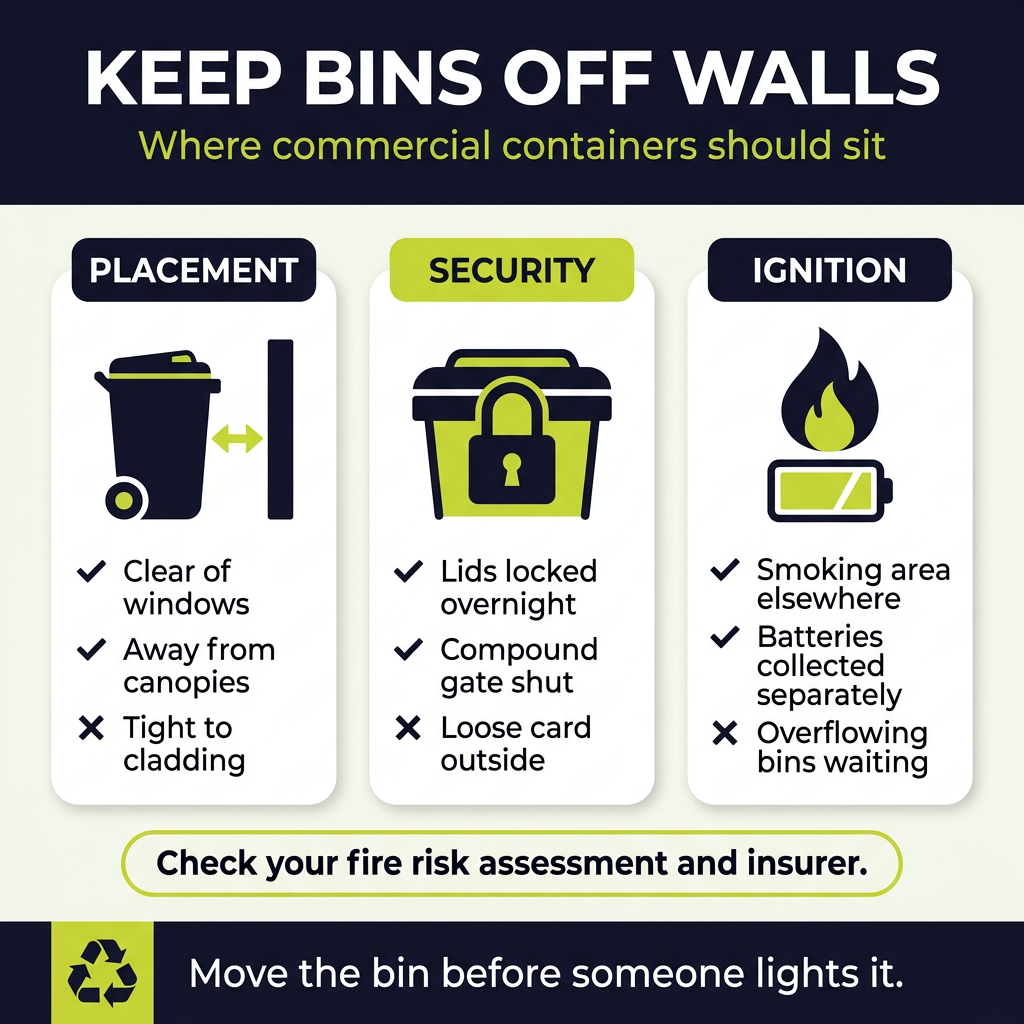
Where commercial containers should sit
The answer is away from the building, not against it.
There is no single distance that suits every site. The right gap depends on the wall, the openings above it, the container size and the building’s use.
Your fire risk assessor should set the figure for your site. Treat their number as the minimum, not a target.
As a working rule, keep containers clear of these:
Windows and doors, including fire exits and their escape routes.
Canopies, eaves, soffits and overhanging roofs.
Timber, plastic or composite cladding.
Air intakes, vents and plant rooms.
Gas meters, fuel stores and anything that burns easily.
If the site has no room for that gap, a secure compound is the better answer. A walled or fenced pen away from the building keeps containers in one place.
Skips and temporary containers
Skips cause the same problem on a larger scale. They arrive for a refit or a clearance, and they land wherever the driver finds space.
Agree the skip position in advance. Mark the spot before delivery, well clear of windows, doors and overhanging structures.
Open skips collect other people’s rubbish overnight, including mattresses, furniture and flammable packaging. Consider a lockable skip or an enclosed container for longer hires.
Arrange prompt removal once the work finishes. A full skip left standing for a fortnight is an unnecessary temptation.
Lock the lids, lock the compound
An open bin invites people in. A locked bin gives them nothing to light.
Fit locks or gravity locks to lids. Most wheelie bins and front end containers take them. They also stop fly tipping into your bins.
Lock the compound gates outside working hours. A gate left open every night provides no protection at all.
Chain or brake the containers. If anyone can wheel a bin against the wall at midnight, it will end up there.
Give staff a simple closing routine and include it in induction training. Lids down, gate shut, key back in the office.
Overflowing bins are fuel
Cardboard is the problem stream on most sites. It is dry, light and catches in seconds.
Boxes stacked beside a full bin are the worst case. They sit on the ground, they are easy to reach and they burn well.
Flatten every box. Flat card takes far less space, so it stays inside the container.
Never leave loose bags or card on the ground. If it does not fit inside, the container is too small or emptied too rarely.
Our guide to cardboard recycling for businesses covers balers, cages and the right containers for heavy card. For the collection itself, our paper and cardboard service handles card in volume.
Collection frequency matters
A bin that fills by Wednesday and waits until Monday is a fire risk for five days.
Match lifts to the real fill. If the bins overflow before collection, book more lifts or a bigger container.
Watch for predictable peaks. Retail deliveries, stocktakes, refurbishments and seasonal rushes all produce additional card and packaging.
Book extra lifts before the peak, not after the overflow. Our guides to retail waste management and warehouse waste management look at how busy sites plan for it.
Unsure which container suits the job? Our comparison of skips, wheelie bins and clearance crews sets out the options.
Keep smoking areas away from bins
A dropped cigarette end in a bin of dry card can smoulder for hours. Nobody notices until it flares up at night.
Move the smoking shelter. It should sit well clear of the bin store, not beside it.
Provide proper metal ash bins with lids. Staff will use them if they are close to where people actually stand.
Tell staff and contractors never to empty ash bins into general waste. Let the contents cool fully first.
Put up a no smoking sign at the bin store. It makes the rule clear to delivery drivers as well as staff.
CCTV and lighting
Arson is far easier in the dark, with nobody watching the premises.
Light the bin store. A motion sensor light deters loiterers and helps staff on early shifts.
Point a camera at the compound if you already operate CCTV. Recorded footage helps the police investigation and your insurance claim if something does happen.
Keep the area tidy and visible from the road wherever possible. Hidden corners attract unwelcome attention.
None of this replaces distance and locks. It adds a second layer on top.
Batteries in general waste
Not every bin fire starts with a match.
Lithium batteries in vapes, phones, tools and laptops can ignite when crushed. A collection lorry or a compactor does exactly that.
Keep batteries out of general and recycling bins. Give them their own collection point inside the building.
Batteries and electrical waste need a specialist route. Our guide to battery recycling for businesses explains the options.
Moving bins without blocking the lorry
Moving containers away from the wall is the right call. Just do not move them somewhere the lorry cannot reach.
Check access before you move anything. The crew needs a clear, level route from the container to the vehicle.
Avoid steps, kerbs, gravel and steep slopes. Front end containers need the lorry to get close and lift straight up.
Watch for overhead cables, low branches and barriers. A new compound gate must open wide enough for the container.
Tell your waste contractor before the change. They can confirm vehicle access, the lifting equipment and any alteration to the collection time.
Your duty of care covers how you store waste as well as who takes it. Our guide to duty of care rules for UK businesses sets out the basics. Check with your local authority or fire service for anything specific to your site.
Frequently asked questions
How far should commercial bins be from a building?
There is no single figure for every site. Your fire risk assessment should set a safe distance based on the wall, openings and container size.
Do I need a locked bin compound?
Not always, but it is often the simplest fix where space is tight. A locked pen keeps containers away from the building and out of reach.
Can a bin fire affect my insurance?
It can. Many policies include conditions on waste storage, so read yours and ask your insurer if anything is unclear.
Why is cardboard a fire risk?
It is dry, light and catches quickly. Loose boxes beside a full bin are easy fuel for a deliberate fire.
Can batteries start a bin fire?
Yes. Lithium batteries can ignite when crushed, so keep them out of general waste and use a separate collection.
Will moving my bins affect collections?
It might. Check the lorry can still reach the containers, and tell your waste contractor before you move them.
The bottom line
A bin against the wall gives a fire a ladder into the building.
Move containers clear of walls, windows and canopies, or put them in a locked compound.
Lock the lids, flatten the card and book enough lifts to stop overflow.
Keep smokers and batteries away from the bins, and light the store at night.
Priority Waste provides commercial waste collections across the UK. Book a free waste review, and we will start with where your bins sit tonight.

