
A warehouse produces the cleanest waste of any commercial site.
Uniform materials, in volume, from a known source, generated by trained staff in a controlled building. Reprocessors want exactly that.
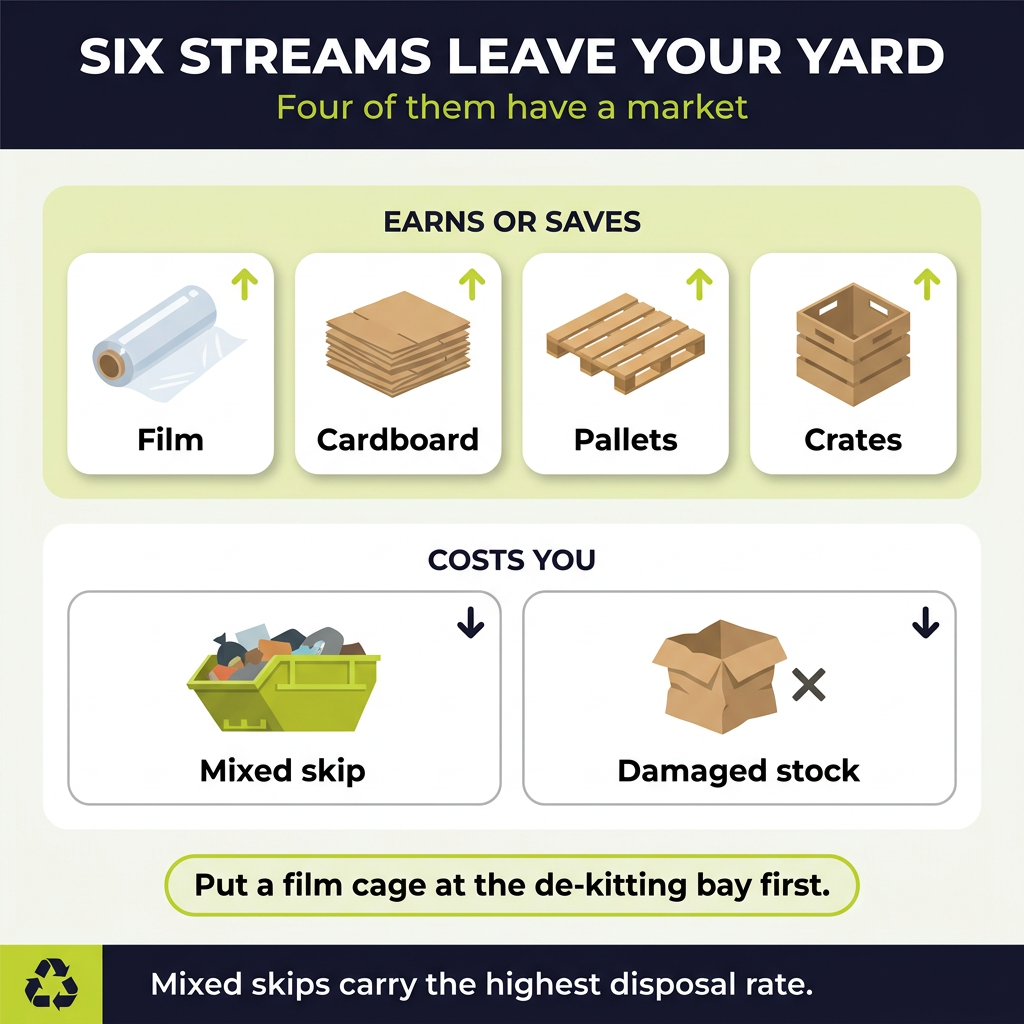
Then most of it goes into one mixed skip in the yard. The site pays to bury material others would buy.
What actually leaves a distribution centre
The list is short, which is the point. Short lists separate well.
Pallet wrap and shrink film. Clean, clear, and produced in steady daily volumes.
Cardboard outer cases. Second only to film in most operations.
Wooden pallets. Broken ones, odd sizes and the ones nobody will collect.
Plastic pallets, crates and trays. Often high grade and worth separating.
Strapping, corner boards and void fill. Mixed materials that need a decision each.
Damaged and returned stock. Small volume, high consequence.
Six streams, four of which have a market. Our plastic and paper and cardboard services handle the two largest.
A site that separates only film and card has already fixed most of the problem. The rest is refinement.
Film is the stream you are giving away
Warehouse film is close to the ideal recyclable, and most sites bin it.
It is clean. Nothing contaminates pallet wrap between the lorry and the racking.
It is uniform. One polymer, usually clear, from one source.
Staff generate it daily in a fixed place. The de-kitting bay, every shift, without variation.
Baled clear film has genuine value. Above certain volumes, it earns rather than costs.
Loose film is mostly air. You are paying to transport nothing.
Put a dedicated cage at the de-kitting point. That one change usually moves more tonnage than any policy.
Why mixed skips look cheap and are not
A single skip is simple, and simplicity has a price attached.
You pay disposal rates on recyclable material. Film and card cost money in a skip and earn or save money out of it.
Mixed waste sits at the top of the price range. Segregated streams cost less per tonne almost everywhere.
Your recycling rate collapses. Anything in a mixed skip counts as residual on your report.
Skips take yard space. A compactor or a baler frees the bay for pallets.
The simplicity argument is real. It is worth less than most operations assume.
The pallet question
Pallets confuse more sites than anything else in the yard.
Standard pallets have a resale and repair market. They should never go in a skip.
Odd sizes and broken ones are wood waste. Recyclable, but on a different route.
Plastic pallets are a plastics stream. Worth separating from the timber.
Pooled pallets belong to somebody else. Losing them creates a charge rather than a waste cost.
Count what leaves before assuming any of it is waste. Most warehouses are throwing away an asset.
Damaged stock is a decision, not a bin
Every warehouse has a bay of it, and the bay grows while people decide.
Some is saleable through legitimate channels. That is a commercial decision.
Some has to go for destruction. Branded goods leaving intact can come back as grey market stock.
Some is a supplier claim. Photograph and record before anything moves.
Some is packaging damage only. Repack and it goes back to stock.
Sort it weekly rather than quarterly. Our product destruction service covers anything that must not leave saleable.
Designing the yard around the streams
This is a layout problem before it is a waste contract.
Put containers where the material appears. The de-kitting bay, the goods-in door, the returns desk.
Never make the right bin the far bin. Staff on a pick rate will use whatever is closest.
Keep routes clear of the MHE traffic. A cage in a forklift aisle will be hit.
Think about the baler position. Next to the card and film sources, not in a corner.
Leave room to manoeuvre a skip lorry. Access failures cause missed collections more often than anything else.
Walk the building with whoever quotes for the contract. A yard drawing hides all of this.
Compactors, balers and when each earns its place
The kit decision comes down to volume and space.
Balers suit card and film. They produce a saleable bale and cut collection frequency.
Compactors suit high-volume residual. They reduce lifts on the stream with no resale value.
Both need a routine. A machine nobody empties becomes an obstruction.
Both need power and a footprint. Neither is a corner-of-the-yard decision.
Volume decides it, not enthusiasm. Tell us your weekly tonnages, and we will give you a straight answer.
Second-hand kit is worth a look. A refurbished baler at the right throughput pays back faster than a new one.
Multiple sites, one contract
Operators running several depots hit the same problems as retail estates.
Prices vary between sites doing identical work. Nobody benchmarks without central visibility.
Somebody assembles the reporting by hand. Every time anyone asks.
Compliance evidence sits in site offices. Until a client audit needs all of it at once.
Good practice does not travel. The site that sorted its film properly never tells the others.
Our national total waste management service exists for this problem.
Third-party logistics has an extra wrinkle
A 3PL handles somebody else’s stock, and that changes the paperwork.
The producer is usually your client. Duty of care follows the material, so agree who holds it in writing.
Client stock cannot just be skipped. Damaged goods belong to them, and the decision is theirs.
Reporting may be contractual. Several clients will want tonnage and recycling figures for their own reports.
Segregation standards vary by client. One contract may demand more than another on the same site.
Settle all four at onboarding. Retrofitting them across live contracts is much harder.
Frequently asked questions
Can pallet wrap and shrink film be recycled?
Yes, and it is one of the best commercial streams there is. Warehouse film is clean, uniform and produced in steady volume.
Keep it separate from dirty sacks and other packaging, and bale it above a certain throughput.
Is a mixed skip cheaper than separate containers?
It is simpler, not cheaper. Mixed waste carries the highest disposal rate, and it turns recyclable material into residual on your report.
Separating film and cardboard alone changes the economics on most sites.
What should we do with broken pallets?
Standard sizes have a repair and resale market and should not go in a skip. Odd sizes and broken timber go down a wood waste route.
Check first whether any of them belong to a pallet pool.
Do we need a baler?
Above a certain weekly volume of cardboard or film, usually yes. It cuts collection frequency and produces a bale with real value.
Below that, the space, power and labour do not pay back. Tell us your tonnages, and we will be straight about it.
How should we handle damaged stock?
Sort it weekly into four outcomes: saleable, supplier claim, repack, and destroy.
Anything branded that must not reach a grey market needs secure destruction with a certificate, not a skip.
Where should the bins go in a warehouse?
Where the material is generated, which usually means the de-kitting bay, goods-in and the returns desk.
Keep them out of forklift aisles, and never make the correct container the furthest one.
We run six depots. Should they be on one contract?
Usually, because it makes pricing comparable and puts compliance evidence in one place.
Map the notice periods on the existing arrangements before planning any transition.
The bottom line
A warehouse produces the waste a reprocessor most wants, and most warehouses mix it into a skip.
Put a film cage at the de-kitting bay before you change anything else. It is the single biggest move available.
Separate the cardboard, work out which pallets are assets, and sort damaged stock weekly rather than quarterly.
Then walk the yard with whoever quotes, because access and layout decide more of this than the rate card does.
Priority Waste provides waste management for warehouses and distribution centres across the UK. That covers baled film and cardboard, pallet routes and secure stock destruction. Book a free waste review, and we will start at the de-kitting bay.

