
A supplier tells you their service is zero waste to landfill. You put it in the sustainability report.
Eighteen months later, a client auditor asks what the phrase covers, and the room goes quiet.
The claim is usually true. It is also narrower than the sentence sounds. That gap is where reputations get dented.
The three numbers people mix up
Most waste reports carry three figures, and they measure different things.
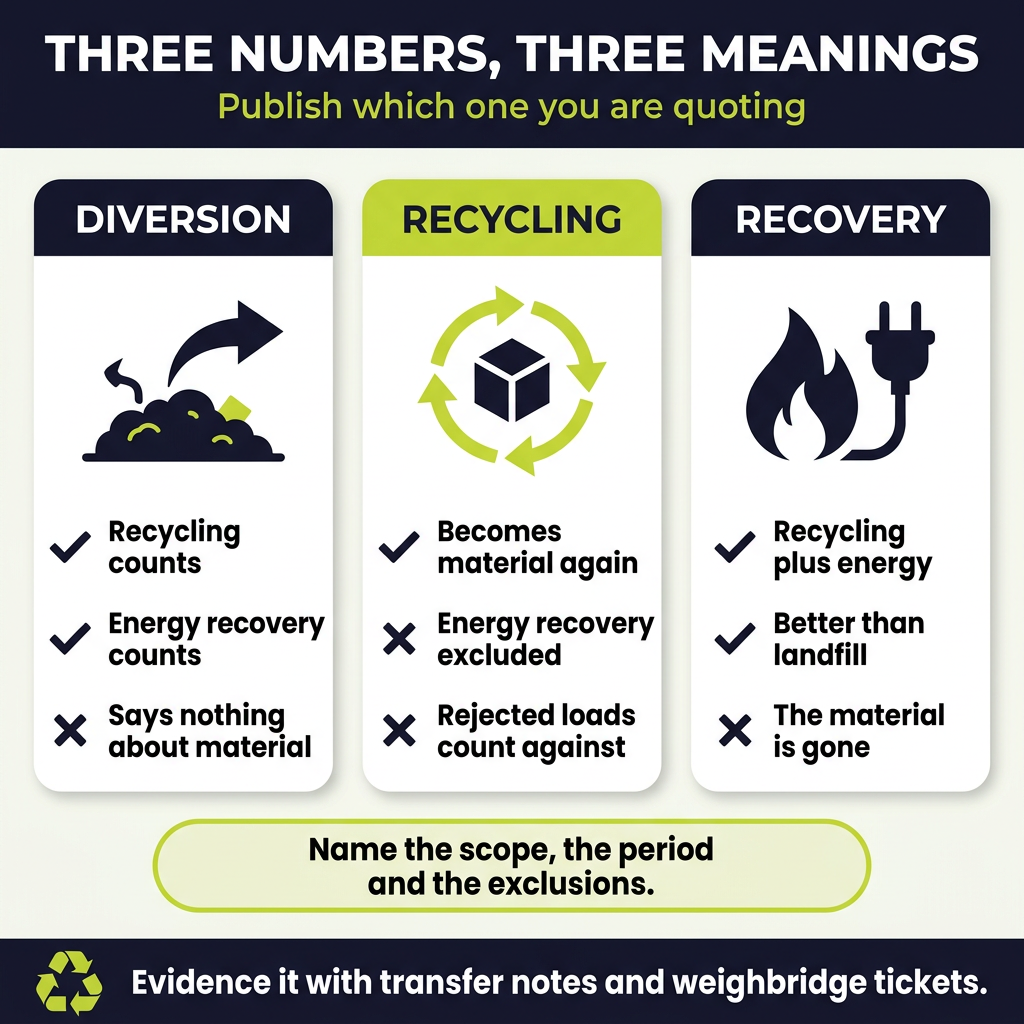
Diversion from landfill. The share of your waste that went anywhere other than landfill. Energy recovery counts here.
Recycling rate. The share that became material again. Energy recovery does not count here.
Recovery rate. Recycling plus energy recovery, and sometimes composting, depending on who wrote the definition.
A site can divert everything and recycle very little. Both statements are true at once, and only one of them impresses a client.
If you publish a figure, publish which of the three it is. That single line prevents most awkward conversations.
What energy from waste actually does
Energy recovery is the reason diversion figures look so healthy, so it is worth understanding.
The plant burns residual waste to generate electricity and heat. Modern facilities feed both the grid and district heating networks.
It is better than landfill on most measures. It avoids methane, and it recovers some value from material nobody sorted.
It is worse than recycling on almost all of them. The material is gone, and a new one has to be made.
Bottom ash still needs handling. Some of it goes into aggregate, and a smaller residue goes to landfill.
So energy recovery is a genuine improvement and a genuine compromise. Reports that treat it as a win with no caveat invite questions.
What a zero-to-landfill claim usually means
Read any claim against three tests before you repeat it.
Which waste does it cover? Often the general waste stream only, not the whole site and not the whole contract.
Does it include residues? Bottom ash, sorting rejects, and process residues are the usual exclusions.
Is it the supplier’s operation or yours? A carrier can run a zero-to-landfill operation while your own site still sends skips elsewhere.
None of that makes the claim dishonest. It makes it specific, and specificity is what your auditor wants.
Where the figures come from
You cannot report what you cannot evidence, and this is where most reports weaken.
Waste transfer notes are the base record. They name the carrier, the waste and the destination.
Weighbridge tickets carry the tonnage. Estimated weights are the first thing an auditor challenges.
Facility permits show the route. A permitted site’s licence tells you what it may do with your material.
Carrier reports aggregate it. Ask for the underlying figures rather than a single headline percentage.
Your duty of care records and your sustainability numbers come from the same paperwork. Treat them as one file.
Why contamination quietly lowers your rate
Your bin does not decide the recycling figure. The sorting facility decides it.
A rejected load becomes residual waste. It then counts against your recycling rate, not for it.
Nobody tells you unless you ask. Rejection usually appears as a charge, not as a conversation.
One bad bin can outweigh months of good ones. Especially where volumes are lumpy.
Ask for reject rates by stream. It is the fastest way to find which bin needs relabelling.
Our guide to contamination rules covers what actually causes rejections.
What an auditor will ask you
Certification and client audits follow a familiar path. None of these questions is hard if the file exists.
- Show me waste transfer notes for the last two years.
- Where did this stream physically go, and under what permit?
- How was this tonnage measured, and by whom?
- What does your published figure include and exclude?
- What is your reject rate, and what did you do about it?
- Who is the named person responsible for waste here?
Question four is the one that catches people. A number with no definition behind it reads as a marketing claim.
Writing a claim you can defend
Be specific, and you will never have to walk anything back.
Name the scope. Which sites, which streams, which period.
Separate recycling from recovery. Two numbers, clearly labelled, not one blended figure.
State the exclusions. Residues, hazardous streams and anything handled by another supplier.
Say who produced the data. Your carrier, from transfer notes and weighbridge tickets.
Keep the evidence with the claim. The file should sit where the report sits.
A modest, evidenced figure survives an audit. An impressive, undefined one does not.
How to actually improve the number
Reporting honestly is one job. Moving the figure is a different one.
Segregate more streams at source. Every stream you separate is a stream that leaves the residual bin.
Right-size the containers. Half-empty bins collected weekly do nothing for the rate and cost a great deal.
Fix the worst bin first. One contaminated stream usually explains most of the shortfall.
Consolidate the reporting. Consistent data across sites, which is part of what national contracts exist to provide.
We look at all four in a free waste review.
The claim that ages badly
One more warning, and it applies to every figure you publish.
Suppliers change. A route that was true last year may not be true now, and nobody will write to tell you.
Facilities change permits. The destination on last year’s notes may handle your material differently today.
Your own waste changes. A new product line or a new packaging spec moves the mix.
So date every claim. A figure with a period attached ages honestly. A figure with no date attached just becomes wrong.
Frequently asked questions
Does zero waste to landfill mean nothing goes to landfill?
Rarely in the literal sense. Most claims cover a defined stream and exclude process residues such as bottom ash and sorting rejects.
Ask what the claim covers before you repeat it in a report.
Does energy from waste count as recycling?
No. Energy recovery counts towards diversion from landfill and towards a recovery rate, but not towards a recycling rate.
Publishing the two figures separately is the clearest way to avoid a dispute.
What is the difference between diversion and recycling?
Diversion measures what was diverted from landfill by any route. Recycling measures what became material again.
A site can divert almost everything while recycling a modest share of it.
How do we evidence our waste figures?
Waste transfer notes, weighbridge tickets and the permit details of the receiving sites. Ask your carrier for the underlying tonnages rather than a headline percentage.
Estimated weights are the first thing an auditor challenges.
Does a contaminated load affect our recycling rate?
Yes. A rejected load becomes residual waste and counts against the rate.
Ask your carrier for reject rates by stream, because rejections usually show up as a charge rather than a conversation.
What should we publish if we are not sure?
Publish the narrow, evidenced figure and name its scope. A modest number with a clear definition survives scrutiny.
An impressive number with no definition is the one that causes trouble later.
Who is responsible for the accuracy of the claim?
Your business, because it is your report. The carrier supplies data, but the published statement is yours to defend.
Keep the evidence file alongside the claim so you can produce both together.
The bottom line
Zero to landfill is a useful claim and a narrow one. It almost always means a defined stream, with residues excluded.
Publish diversion and recycling as two figures, each with its scope written next to it.
Get your tonnages from weighbridge tickets and transfer notes rather than estimates, and ask for reject rates by stream.
Then fix the worst bin. One contaminated stream usually explains most of the gap between your rate and the one you wanted.
Priority Waste provides consolidated waste reporting for single and multi-site businesses across the UK. Every figure is built from transfer notes and weighbridge data.
Book a free waste review, and we will show you what your figures can actually evidence.

