
Site waste management plans stopped being a legal requirement in England back in 2013.
Almost nobody noticed, because clients carried on asking for them. Principal contractors ask. Funders ask.
ISO 14001 auditors ask too, and they want the figures in the back.
So a document that the law dropped is now a document the market insists on. And the sites that write one properly finish tidier and cheaper than the sites that do not.
What a site waste plan actually is
Strip away the template, and it is a short answer to four questions.
What waste will this job produce? By type, and roughly by quantity.
Where will each stream go? Named carrier, named destination, correct route.
Who is responsible on site? One person, by name, not a job title on an org chart.
What actually happened? The plan is worth nothing without the figures filled in afterwards.
Everything else in a template hangs off those four. Our site waste plan service builds them around the job rather than around a form.
Why it survived the repeal
Four pressures replaced the legal one, and between them they are stronger.
Clients write it into tenders. Public sector and large private clients ask for a plan as a condition of the contract.
Certification schemes expect it. ISO 14001 and BREEAM both want evidence of planned, measured waste management.
Funders and planners attach conditions. Many planning consents carry waste and recovery conditions with reporting attached.
Duty of care never went away. Repealing the plan did not repeal your duty of care.
Scotland kept its own requirements, so a UK-wide contractor should not assume England’s position applies everywhere.
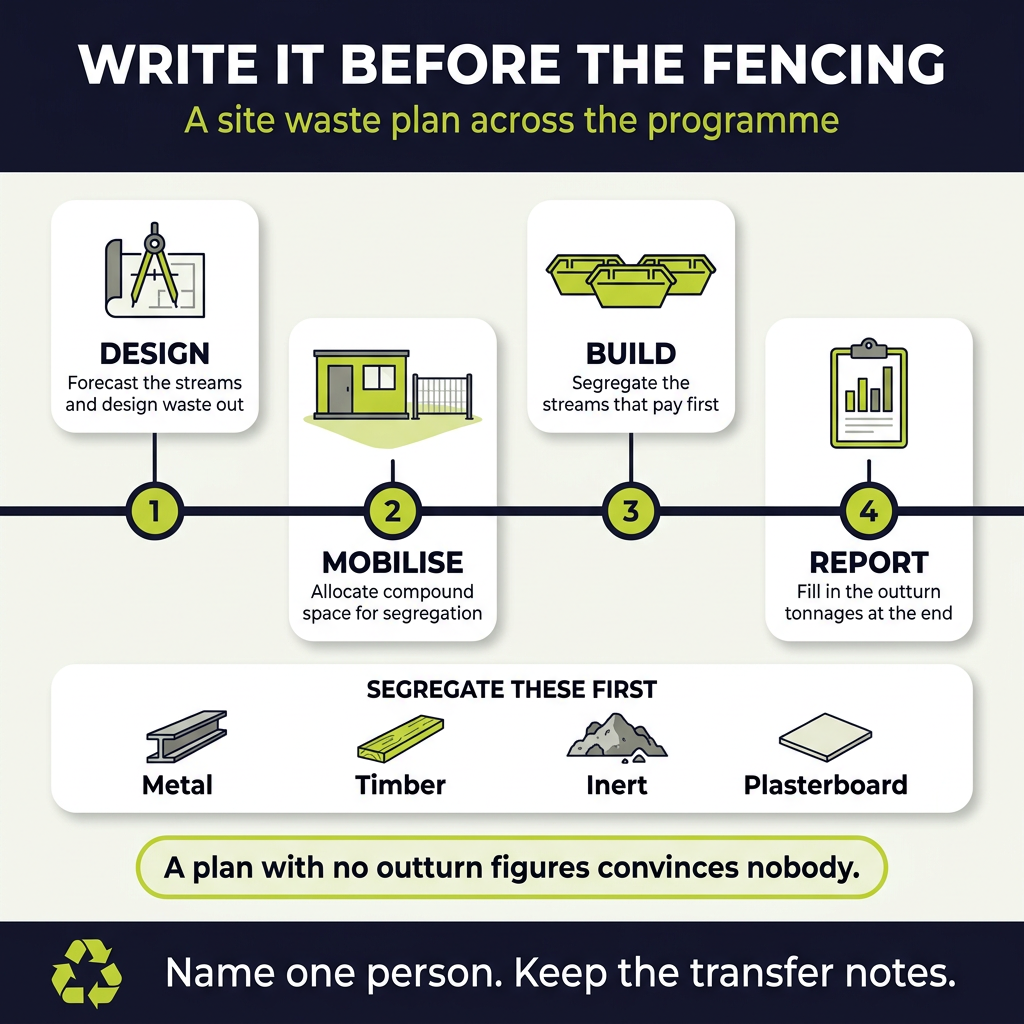
Write it before the fencing goes up
The plan is a design stage document that most sites write as a retrospective. That is where the value leaks out.
Early means you can design waste out. Standard sheet sizes, ordered quantities and off-site fabrication all cut waste before it exists.
Early means the compound has space. Segregation needs room, and you allocate room in week one, not week ten.
Early means the budget is real. Waste costs that appear on the plan get priced. Costs that appear later come out of margin.
Late means it is a paperwork exercise. A plan written for the file changes nothing on the ground.
The same logic runs through our guide to why tidy sites finish faster.
The streams to plan for
Most jobs produce a predictable set. Plan for the ones you will actually see.
- Inert material, meaning soil, hardcore, concrete, brick and rubble
- Timber, split between clean and treated
- Metals, which usually carry a rebate rather than a charge
- Plasterboard, which needs separating and cannot go to general landfill
- Packaging, meaning cardboard, shrink wrap and pallets
- Insulation and plastics
- General mixed waste, which should be the smallest container on site
- Hazardous items, such as asbestos, paints, sealants, fuels and contaminated soil
That last line is a different conversation with different paperwork. Identify it at survey stage, never on the day.
Segregation on a site with no room
Every contractor agrees with segregation in principle and then runs out of compound.
Start with the two that pay. Metal and clean timber earn or save money on almost every job.
Add inert if the volumes justify it. A dedicated muckaway beats mixed skips wherever the quantity is real.
Use the phases. A strip-out phase and a fit-out phase produce different waste. The bays can change with them.
Accept a mixed skip for the remainder. A well-run site with three segregated streams and one mixed skip beats a site with eight bays nobody uses.
Our guide to choosing between a skip, a bin or a clearance crew covers the container decision.
The numbers that go in the back of the plan
A plan without outturn figures is half a document, and it is the half auditors skip to.
Tonnage by stream. Straight from the transfer notes, not estimated.
Diversion from landfill. The headline figure clients ask for.
Recovery and recycling rates. Separate numbers, because they mean different things.
Variance against the forecast. Where you overran, and why.
Carrier and destination records. Licence details and permitted sites, kept with the notes.
Ask your carrier for this in one report rather than reconstructing it from a file of tickets.
The mistakes that cost the most
Four recurring ones, and they are expensive in different ways.
Nobody owns it. A plan with no named person gets updated by nobody.
Hazardous material appears mid-job. Asbestos found during strip-out stops work and rewrites the programme.
Skips get ordered out of habit. The same size, on the same day, whatever the phase needs.
Nobody collects the transfer notes. They sit somewhere in a cabin, and the client asks for them nine months later.
Every one of those is a planning failure rather than a waste failure.
What to ask your carrier before the job starts
Five questions, and the answers shape the compound layout.
Which containers fit this access? Site access decides container choice more often than volume does.
What is the lead time on an exchange? A full skip on a Friday with a Monday exchange stops work.
Which streams carry a rebate at my volumes? Metal usually does. Timber and inert sometimes do.
Will you report tonnage by stream? You need it for the back of the plan.
Who covers a wasted journey? Blocked access happens, and the charge should be clear in advance.
Frequently asked questions
Are site waste management plans still a legal requirement?
Not in England, where the regulations went in 2013. Scotland keeps its own requirements, so UK-wide contractors should check the position per project.
Clients, funders, planning conditions and certification schemes now ask for them regardless.
When should the plan be written?
At the design or pre-construction stage, before the compound is laid out. That is when you can still design waste out and allocate space for segregation.
A plan written after work starts becomes a record rather than a plan.
What goes in a site waste management plan?
Forecast waste types and quantities, then the route and destination for each stream. Add the named person responsible and the outturn figures once the job finishes.
Carrier licence details and copies of transfer notes belong with it.
How much should we segregate on a tight site?
Start with metal and clean timber. Add inert where the volumes justify it, and accept one mixed skip for the rest.
Three streams used properly beat eight bays that staff ignore.
Why can plasterboard not go in a general skip?
Gypsum generates hydrogen sulphide when it breaks down with biodegradable waste, so it needs separating from mixed loads.
Plan a dedicated container wherever the job involves any meaningful quantity.
Who is responsible for construction waste on site?
The producer, which in practice means the principal contractor. Duty of care does not pass to a subcontractor or transfer to the carrier.
Name one person in the plan and give them the transfer notes to hold.
What happens if asbestos turns up mid-project?
Work stops in that area until a licensed specialist surveys and handles it. It is hazardous waste with consignment note requirements.
A pre-demolition survey, before you fix the programme, costs far less than finding it during strip-out.
The bottom line
The plan is no longer a legal duty in England, and it is now a commercial one. Clients ask, auditors ask, and the good sites use it to save money.
Write it at the design stage, while you can still change the order quantities and the compound layout.
Segregate the streams that pay first, and let the rest go in one well-managed mixed skip.
Then fill in the outturn figures, because a plan with no numbers in the back convinces nobody.
Priority Waste supports construction and demolition projects across the UK with site waste planning, segregated container supply and consolidated reporting. Book a free waste review, and we will build the plan around the programme.

