
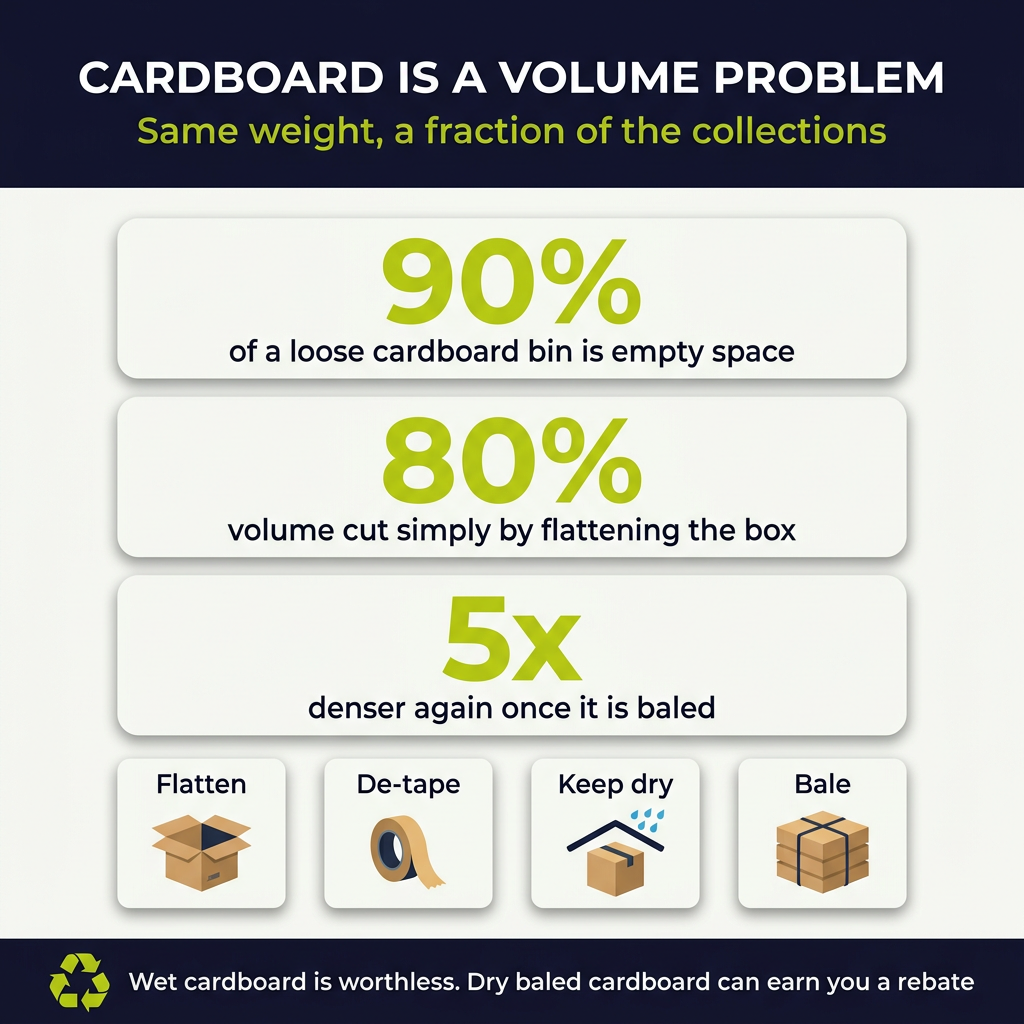
A 1,100-litre wheelie bin full of loose, unflattened cardboard boxes is roughly ninety per cent empty space.
You are not paying to dispose of cardboard. You are paying a lorry to drive to your premises and collect air, and then paying again when it fills up before the next scheduled collection and somebody orders an extra lift.
Cardboard is the highest-volume, lowest-density waste stream most retail, warehouse and manufacturing businesses produce. It is also the one where the gap between a well-run operation and a badly-run one is widest.
Why cardboard behaves differently from every other stream
Most commercial waste is priced primarily on weight. Cardboard is priced on the space it occupies, because it weighs almost nothing and takes up a great deal of room.
That single fact drives everything else. Your cost is not really about how much cardboard you produce. It is about the density you present it in.
Flatten a box, and you cut its volume by roughly eighty per cent. Bale that flattened cardboard, and you cut it again by a factor of five or more. Same material, same weight, a fraction of the collection.
The businesses paying the most per tonne for cardboard are almost never the ones producing the most cardboard. They are the ones storing it loosest.
What your cardboard is actually worth
Clean, dry corrugated cardboard has a genuine market value. In the trade, it is usually called OCC, meaning old corrugated containers, and it is a globally traded commodity.
At sufficient volume, and in baled form, it can generate a rebate rather than a cost. Below that threshold, it typically reduces your bill rather than reversing it.
Three things determine which side of that line you land on.
Density. Loose cardboard almost never earns a rebate, because the transport cost swamps the material value. Baled cardboard can.
Cleanliness. Wet cardboard is worthless. Greasy cardboard is worthless. So is cardboard with large amounts of tape, plastic film, polystyrene inserts, or staples still attached.
Consistency. A mill or a merchant will pay more for a reliable monthly tonnage than an unpredictable one. Predictability is worth real money in this market.
Baler or compactor: they are not the same machine
These two get used interchangeably, and they do very different jobs.
A baler compresses material into dense, strapped, stackable bales. Those bales have a resale value and can be stored on a pallet until you have enough to justify a collection. Balers suit cardboard, plastic film and paper. A mill-size bale is what earns a rebate.
A compactor crushes waste into a sealed container that is then swapped out whole. Compactors suit mixed and residual waste, and high-volume operations where the material has no resale value. The output is simply less waste, not a saleable bale.
For a business whose main problem is cardboard, a baler is nearly always the right answer.
The maths on a baler is straightforward. Add up your current cardboard collections per month, including the unscheduled extra lifts. Compare that to the reduced collection frequency a baler allows, plus any rebate on the bales, minus the machine cost and the labour to run it. Most retail and warehouse operations producing steady cardboard volume find the payback period is measured in months rather than years.
Below a certain volume, the machine cannot pay for itself and loose or flat-packed collection remains correct. Any provider recommending a baler should show you that calculation rather than asserting it.
The paper problem, which is a different problem
Paper and cardboard get grouped together on invoices, but they behave differently.
Office paper is lighter, higher grade and worth more per tonne than cardboard, but almost no office produces enough of it to matter commercially. The bigger issue with office paper is confidentiality rather than value.
Anything with a name, an address, a payroll figure, a customer record or a supplier price on it is a data risk, not a recycling opportunity. That material belongs in a secure shredding stream with a certificate of destruction, not in the cardboard bin. Our piece on what businesses bin without thinking covers where the line sits.
Newspaper, magazines and brochures are low value and are usually best handled inside dry mixed recycling rather than as a separate stream.
The practical rule: cardboard on its own if you have volume, confidential paper separately and securely, everything else into DMR.
Six changes that cut cardboard cost without buying anything
Before any capital spend, these are free.
Flatten at the point of unpacking. Not later, not in the yard. The moment the box is empty. A box that gets carried to the bin whole never gets flattened.
Put a blade where the boxes are opened. Sounds trivial. It is the most reliable fix on this list.
Strip tape and film before flattening. Both are contaminants, and both are quick to remove while the box is still on the bench.
Keep it under cover. Wet cardboard loses its value entirely and gets heavier, which can move it into a higher weight band. An outdoor open bin in a British winter is a cost multiplier.
Match your collection frequency to your actual peaks. Most businesses have a delivery day. If your cardboard arrives on a Tuesday and your collection is on a Monday, you are storing a week’s worth of it for no reason.
Stop ordering extra lifts by reflex. Every unscheduled collection is priced as an exception. Two of those a month usually means the schedule is wrong, and the schedule is cheaper to change than the exceptions are to keep paying.
Frequently asked questions
Do businesses get paid for cardboard recycling?
Sometimes. Clean, dry, baled cardboard has a commodity value and can generate a rebate at sufficient volume. Loose cardboard usually does not, because the cost of transporting mostly empty space cancels out the material value. Most small businesses see cardboard reduce their overall waste bill rather than produce a payment.
Is a baler worth it for a small business?
It depends entirely on your cardboard volume and your current collection frequency. The calculation is your current monthly collections, including unscheduled extra lifts, against the reduced frequency a baler allows plus any bale rebate, minus machine and labour cost. Ask your provider to show you that figure using your actual collection data before committing.
What is the difference between a baler and a compactor?
A baler compresses material into dense, strapped bales that can be stored, stacked and sold. A compactor crushes waste into a sealed container that is swapped out whole and has no resale value. Balers suit recyclable materials like cardboard, paper and plastic film. Compactors suit high volumes of mixed or residual waste.
Can waxed or greasy cardboard be recycled?
No. Wax coating and food grease both break down the paper fibres and contaminate the load around them. Waxed produce boxes, greasy takeaway packaging and pizza boxes all need to go into residual waste, not the cardboard stream. Putting them in can cause the whole load to be downgraded.
Should cardboard go in dry mixed recycling or a separate bin?
If you produce cardboard in meaningful volume, a separate stream is almost always cheaper, because the material stays clean and can be baled. If your cardboard is occasional and low volume, it is usually better inside dry mixed recycling, where it shares a collection with your other recyclables rather than triggering one of its own.
The bottom line
Cardboard costs are a density problem wearing the costume of a waste problem.
Flatten it, keep it dry, strip the tape, and match the collection to the delivery day. Do those four things and most businesses cut their cardboard cost before anyone has to talk about buying a machine.
Priority Waste runs dedicated cardboard and paper collections for businesses nationally, and will run the baler payback numbers on your actual collection data rather than a generic estimate. Book a free waste review to get the figure for your site.

