
Designers plan the shop floor to the centimetre. Every fixture, every sightline, every bay.
The stockroom is whatever was left over. And the waste arrangements are whatever fits in the stockroom.
So the same thing happens in shop after shop. Delivery lands, cardboard piles up by the fire door, and somebody spends an hour of trading time dealing with it.
Retail waste is a delivery problem in disguise
Almost everything you throw away arrived in a van that morning.
Cardboard outer cases. The single biggest stream in most shops by volume.
Shrink wrap and pallet film. Light, bulky and usually binned with the general waste.
Hangers, security tags and shoe boxes. Fashion produces these in quantities nobody forecasts.
Pallets and dollies. Returnable in many supply chains, and dumped in the rest.
Damaged and returned stock. Small in volume, awkward in handling.
Waxed and laminated boxes. Chilled and produce cases often carry a coating that keeps them out of the cardboard stream.
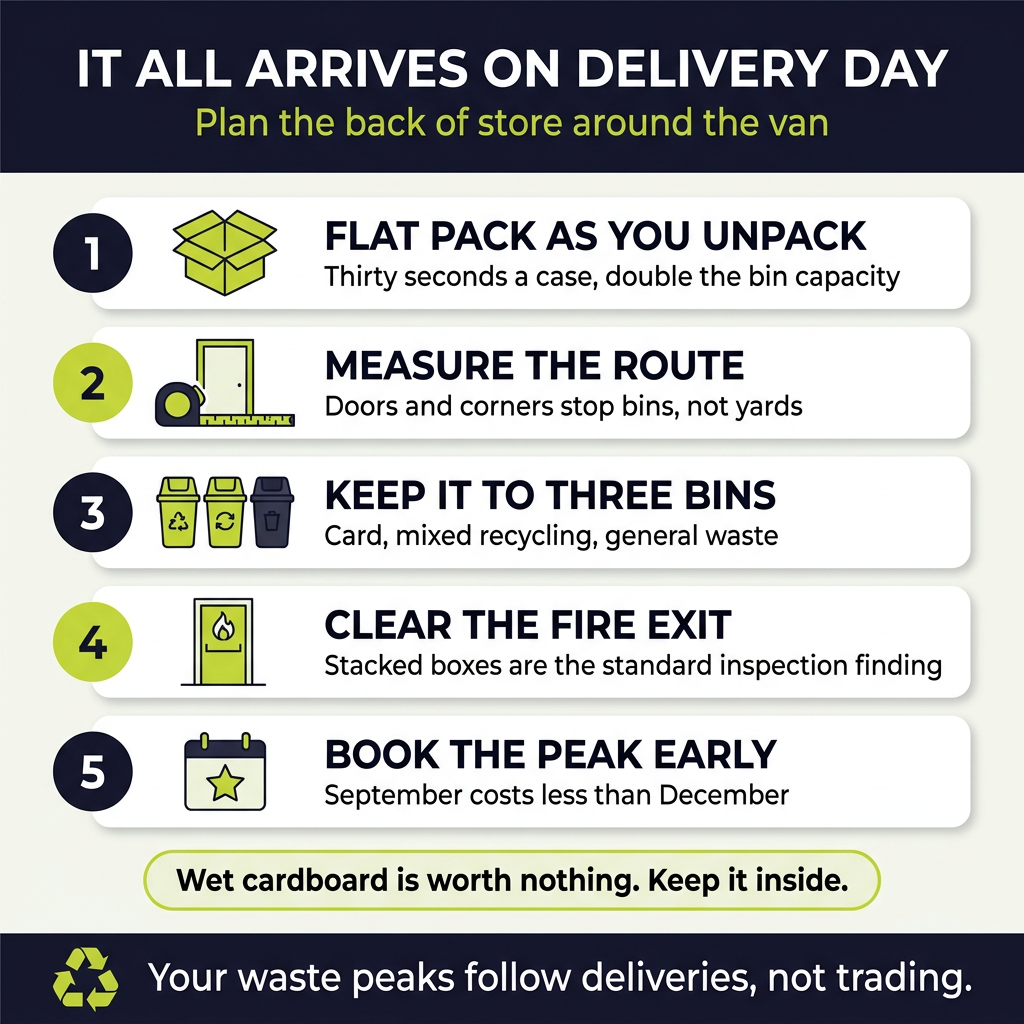
That means your waste peaks match your delivery schedule, not your trading pattern. Plan around the delivery day.
Cardboard is the whole game
Get cardboard right, and most of the problem disappears. Get it wrong, and it fills the corridor.
It is largely air. A loose box takes up ten times the space it needs to.
Flat packing is free, and nobody does it. Thirty seconds per case, and it doubles your container capacity.
Balers change the maths above a certain volume. Fewer collections, and baled card holds real value.
Wet cardboard is worth nothing. An open yard in November turns a valuable stream into general waste.
Our guide to balers and the volume problem covers when the machine earns its keep.
Why the stockroom is the real constraint
Container size decisions get made on price. They should get made on the floor plan.
Measure the space before ordering bins. A 1100 litre bin needs a door it fits through and a route it can travel.
Check the access route, not just the yard. Steps, tight corners and fire doors stop bins more often than yards do.
Shared service yards have their own politics. In a shopping centre or a parade, somebody else runs the yard.
Fire exits are not storage. Cardboard stacked by a fire door is the finding every inspection produces.
Check the lease and the centre rules. Many shopping centres set collection windows, approved routes and even container types.
Tell us the constraints before we quote. A container that does not fit is worse than one a size down.
Seasonal peaks break annual contracts
Retail volumes are not flat, and a contract written in February is wrong by November.
Christmas is three to four times normal volume in most categories.
Seasonal ranges land in one delivery. A full range changeover produces a week of exceptional waste.
Sale periods produce packaging and returns together. Both peak at once.
Ad hoc lifts at peak are the expensive option. They cost more than a temporary schedule uplift.
Storage space shrinks at exactly the wrong moment. The stockroom is fullest when the bins are fullest.
Agree on the peak arrangement in advance. Booking it in December costs more than booking it in September.
What your invoice is probably doing
Retail waste bills carry more line items than most, and shops rarely check them.
Lift charges on half-empty containers. Above all on the quiet days between deliveries.
Ad hoc collections that became routine. Three extra lifts a month means the schedule is wrong.
Contamination charges. Usually from one bin, usually fixable with a better label.
Container rental on bins nobody uses. A stream that stopped two years ago still has a bin in the yard.
We went through this in detail in our guide to the invoice nobody reads.
Getting shop staff to do it
Retail has high turnover and short inductions. The system has to survive that.
Keep it to three bins. Cardboard, mixed recycling, general. Four is where accuracy drops.
Put them where unpacking happens. Not in the yard, and not behind the stock cage.
Use pictures. A photo label beats a printed policy nobody reads.
Make it part of the delivery routine. Flat pack while you unpack, rather than as a separate job later.
Give one person the job on each shift. A shared responsibility in retail is nobody’s responsibility by Thursday.
Brief every new starter in week one. Contamination tracks staff turnover tighter than anything else.
Our guide to contamination rules explains what actually spoils a load.
Multiple shops, one arrangement
A chain of shops usually has a collection of local arrangements rather than a contract.
Prices vary by more than geography explains. Nobody benchmarks, because nobody can see across the estate.
Compliance evidence sits in twelve stockrooms. Then head office needs it in one week.
Store managers solve problems on the spot. Which is reasonable, and which is how ad hoc lifts pile up.
Reporting takes weeks to assemble. If it gets assembled at all.
We covered the consolidation question in full in our guide to multi-site waste contracts.
Food retail changes the picture
A convenience store or a supermarket has a different problem from a fashion unit.
Food waste becomes a major stream. Date-expired stock arrives every single day.
Separate collection rules apply squarely. Food waste needs its own container rather than the general bin.
Odour and pest control drive the frequency. More often, smaller containers, lids closed.
Damaged chilled stock cannot wait. It needs a route that works on the day, not next week.
The packaging streams stay the same. The food stream sits alongside them and sets the collection rhythm.
Frequently asked questions
What waste does a typical shop produce?
Delivery packaging, in the main. Cardboard outer cases first, then shrink wrap, hangers, tags and shoe boxes, plus a small volume of damaged stock.
Food retail adds food waste and a much heavier general stream.
How do we stop cardboard taking over the stockroom?
Flat-pack every case as it is unpacked, as part of the delivery routine rather than a separate job.
Above a certain volume, a baler pays for itself. It cuts collections and adds value to the material.
What size bin should a shop have?
Whatever fits through the doors and along the access route. That is often tighter than the yard suggests.
Measure the route before ordering. Two smaller containers usually beat one nobody can move.
How should we handle the Christmas peak?
Agree a temporary schedule uplift in advance rather than ordering ad hoc lifts on the day.
Booking the arrangement in September costs far less than reacting in December.
Can we get paid for our cardboard?
Above certain volumes, and only if it is clean, dry and baled. Loose, wet cardboard has little or no value.
Ask for the position at your volumes rather than assuming either way.
A single shop rarely reaches the threshold on its own. A group of shops on one contract often does, because the tonnage pools.
Why do we get contamination charges?
Almost always one bin with one recurring problem, such as food or wrapping in the mixed recycling.
Ask your carrier which stream keeps getting rejected, then fix that bin’s label and location.
We have eight shops. Should we use one supplier?
In most cases, yes, because it makes prices comparable and puts compliance evidence in one place.
Keep a local arrangement where a nearby operator clearly outperforms, and check the notice periods before moving anything.
The bottom line
Retail waste is delivery packaging, and it arrives on a schedule you already know. Plan the bins around delivery day rather than trading day.
Flat-pack cardboard arrives as part of unpacking, and keep it dry.
Measure the access route before ordering containers, and keep the fire exit clear, whatever the pile looks like.
Then book your Christmas arrangement in September. Ad hoc lifts at peak are the most expensive waste you will buy all year.
Priority Waste provides waste collection for retailers across the UK, from single shops to national estates. Consolidated invoicing and reporting come as standard. Book a free waste review, and we will start with the stockroom.

